TWA Flight 800: Missile Strike or Fuel Tank Explosion?
On July 17, 1996, TWA Flight 800 broke apart off Long Island minutes after leaving New York, killing all 230 people aboard. Many witnesses described a streak of light, and missile theories followed. After a four-year investigation, the NTSB found that the center wing fuel tank exploded and that no wreckage showed damage from a bomb or missile. In 2014 it denied a petition to reopen the case.
Verdict: Debunked. The weight of the evidence cited below contradicts this claim. How we rate stories
The Story
On the evening of July 17, 1996, TWA Flight 800, a Boeing 747 bound for Paris, took off from New York's Kennedy Airport with 2 pilots, 2 flight engineers, 14 flight attendants and 212 passengers. About 8:31 p.m., at roughly 13,800 feet off Long Island, it broke apart. The cockpit voice recorder ended with a 'very loud sound' lasting a fraction of a second. All 230 people on board were killed.
Moments later the captain of another airliner radioed that he 'just saw an explosion out here.' Hundreds of people on the ground and in the air saw the fireball. The NTSB later counted 736 witnesses, and 258 of them described a streak of light. To many, that sounded like a missile.
The NTSB: wreckage 'contained no evidence of damage from a bomb, high-order explosive (bomb or missile warhead), or from missile warhead entry or detonation.'
The timing raised fears. The NTSB itself noted that 'heightened safety and security concerns' around the 1996 Olympics, an international flight, and a sudden, catastrophic breakup all fed speculation about a bomb or missile. The FBI opened a criminal investigation alongside the NTSB's, and Navy divers searched the seabed.
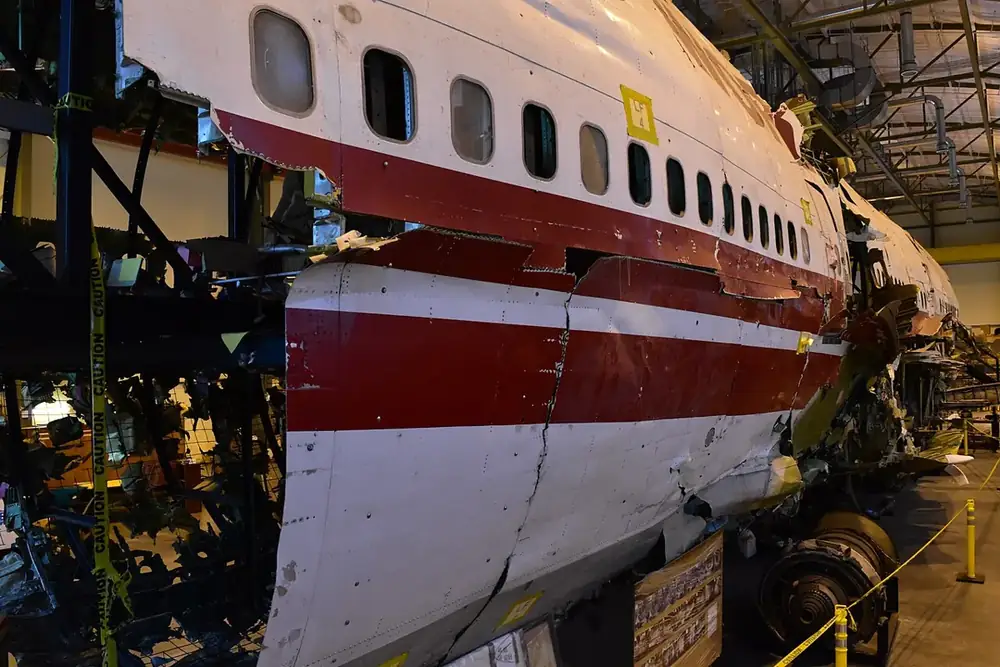
Investigators recovered more than 95 percent of the wreckage and assembled a 93-foot-long reconstruction of the middle of the fuselage in a hangar in Calverton, New York. Experts from the NTSB, the military, the FBI and the ATF looked for any sign of a warhead or bomb. They reported that the wreckage 'contained no evidence of damage from a bomb, high-order explosive (bomb or missile warhead), or from missile warhead entry or detonation.' A medical and forensic review found no localized injuries suggesting an explosive device.
What about the streak of light? CIA analysts who reviewed witness information for the FBI concluded that most of the sightings came after the first explosion, so they could not have been a missile causing it. The remaining accounts, the NTSB quotes them as finding, were 'fully consistent with observations expected if only the aircraft in various stages of crippled flight were being observed.' Military records showed no military surface vessels within 15 nautical miles. A Navy P-3 patrol plane was flying nearby, which theorists often point to; the NTSB recorded its position as part of its radar review.
In August 2000, the NTSB adopted its finding: the center wing fuel tank exploded when the flammable fuel/air mixture inside ignited. The ignition source 'could not be determined with certainty,' but the most likely was a short circuit outside the tank that let excess voltage in through fuel quantity indication wiring. The board also faulted the design approach of trying to prevent tank explosions only by eliminating every ignition source.
The theory did not go away. In 2013, petitioners including former investigators asked the NTSB to reconsider, arguing for an external detonation. On July 2, 2014, the board denied the petition 'in its entirety,' writing that its investigation 'found no evidence of an external detonation, such as a missile.' The verdict here: debunked.
Origins
Flight 800, a Boeing 747 bound for Paris, departed John F. Kennedy International Airport about 8:19 p.m. The FBI ran a parallel criminal investigation, and according to the NTSB's final report, adopted August 23, 2000, the FBI ceased its active investigation in November 1997.
The Claims
- A U.S. Navy missile test went wrong, shot down the plane, and the government covered it up.
- Terrorists shot down the plane with a missile.
- A bomb on board destroyed the plane.
Key Evidence
- The NTSB's witness group counted 736 witnesses, of whom 258 were 'streak-of-light' witnesses.
- The NTSB recorded a U.S. Navy P-3 antisubmarine plane less than 3 nautical miles from the jet at the time. Believers cite this and the witness accounts.
- In June 2013 a group of petitioners, including former investigators, asked the NTSB to reconsider, arguing that a detonation or high-velocity explosion brought the plane down.
The Evidence Against
- The NTSB found 'the probable cause of the TWA flight 800 accident was an explosion of the center wing fuel tank (CWT), resulting from ignition of the flammable fuel/air mixture in the tank,' most likely set off by a short circuit through wiring 'associated with the fuel quantity indication system.'
- The report says pieces of wreckage 'contained no evidence of damage from a bomb, high-order explosive (bomb or missile warhead), or from missile warhead entry or detonation.' More than 95 percent of the wreckage was recovered.
- Military records showed 'no military surface vessels within 15 nm of the accident site' at the time.
- CIA analysts, the NTSB reports, concluded that 'there was absolutely no evidence that a missile was employed to shoot down TWA flight 800.'
- On July 2, 2014, the NTSB denied the reconsideration petition 'in its entirety.'
Documents & Sources
- Gov DocumentOfficial RecordNTSB Aircraft Accident Report AAR-00/03: In-flight Breakup Over the Atlantic Ocean, TWA Flight 800 (adopted Aug. 23, 2000) ntsb.gov ↗
- Gov DocumentOfficial RecordNTSB Response to Petition for Reconsideration, TWA Flight 800 (July 2, 2014) data.ntsb.gov ↗
Each link was checked for availability on Oct. 27, 2026. Links open in a new tab.