Tuskegee Syphilis Study
A real U.S. Public Health Service study that, from 1932 to 1972, followed hundreds of Black men with syphilis in Alabama without treating them, even after penicillin became the standard cure.
Verdict: Confirmed. This one really happened. The core events are documented in the official records and reporting cited below. How we rate stories
The Story
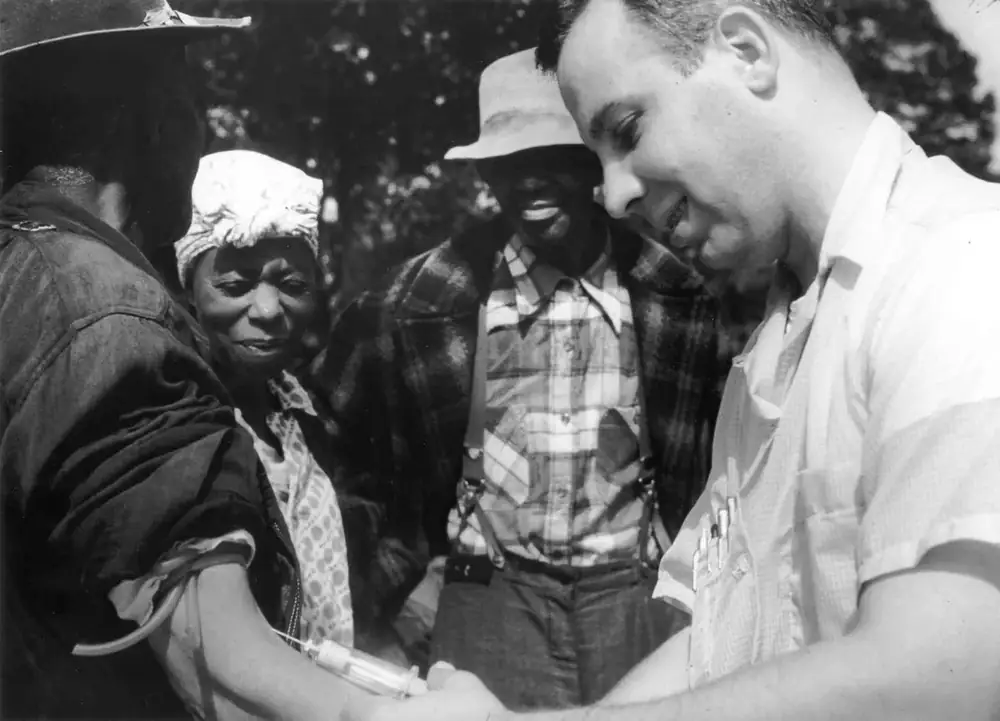
In 1932, in Macon County, Alabama, the U.S. Public Health Service went looking for Black men with syphilis. Working with the Tuskegee Institute, government doctors enrolled 600 men: 399 who had the disease and 201 who did not, according to the CDC. Most were sharecroppers, Smithsonian magazine reports. The men were told they were being treated for "bad blood," a local term that covered several ailments, including syphilis, anemia and fatigue. In return they got free medical exams, free meals and burial insurance. They were never asked for informed consent.
The real goal was to watch what syphilis does to the human body when it is left alone. According to Smithsonian, the study was initially meant to run for six months. It ran for 40 years.
"Nothing learned will prevent, find, or cure a single case of infectious syphilis." (Dr. James Lucas, Public Health Service, 1970 memo quoted in the 1973 federal panel report)
Nobody wrote down a plan for that. When a federal advisory panel examined the study in 1973, it found no original protocol at all. Its final report says that "it can only be assumed" that the decision to make it a long-term study was taken sometime between 1932 and 1936, when the first report on it was published. An annual report of the Surgeon General from 1935-36, quoted by the panel, already noted "success" in gaining permission for autopsies on men who had died.
The men came back year after year for exams, blood draws and spinal taps. According to Smithsonian, which reviewed the study's records after the National Library of Medicine put them online, the men were sent form letters inviting them to a "special examination" and asking "whether the treatment has improved your health." The spinal taps were not treatment. Neither were the aspirin and tonics. None of it did anything for syphilis.
Then the Second World War nearly ended the study by accident. Draft boards tested recruits for venereal disease and ordered treatment. The 1973 panel report says some of the study's men "had already received notices from the Local Selective Service Board 'to begin their antisyphilitic treatment immediately.'" The study sent the board the names of men under 45 and asked that they be left off the list of draftees needing treatment. According to the letters, the panel wrote, the board agreed to this "in order to make it possible to continue this study on an effective basis."
By 1943, according to the CDC, penicillin was the treatment of choice for syphilis and was becoming widely available. The men in the study were not offered it. The panel report cites one of the study's physicians, Dr. O.C. Wenger, as saying that the patients "received no treatment on our recommendation."
The study was no secret inside medicine. Its doctors published papers on it in medical journals. According to Smithsonian, a physician named Count Gibson wrote to question it in 1955 and dropped the matter, and a cardiologist, Irwin Schatz, wrote a letter in 1964 questioning its ethics and never got a reply.
In February 1969, an ad hoc committee met at the government's National Communicable Disease Center to decide whether the study should go on. The 1973 panel's report summarizes how the meeting ended. Among its points: "This type of study would never be repeated," there "were certain medical facts to be learned by continuing the present study," and "Treatment for these patients was not indicated unless they had signs of active syphilitic disease." The study continued. In 1970, the panel notes, a memo by Dr. James Lucas, assistant chief of the Public Health Service's Venereal Disease Branch, said: "It must be fully realized that the remaining contribution from this study will be largely of historical interest. Nothing learned will prevent, find, or cure a single case of infectious syphilis or bring us closer to our basic mission of controlling venereal disease in the United States." The study went on for two more years.
The person who broke it open was Peter Buxtun, a Public Health Service venereal disease officer. According to Smithsonian, he had objected to the study inside the agency for years without result. In 1972 he went to the press. Associated Press reporter Jean Heller broke the story that July.
This time the government moved quickly. An ad hoc advisory panel was appointed to review the study. In October 1972 it advised stopping the study, and a month later the Assistant Secretary for Health and Scientific Affairs announced that it was over, according to the CDC. In its final report the panel called the study "ethically unjustified in 1932" and said its results were "disproportionately meager compared with known risks to human subjects involved." It also found "no evidence" that the men had consented, and it said that penicillin should have been offered to them, "especially as of 1953 when penicillin became generally available." According to Smithsonian, 128 of the men died of syphilis or of complications related to it.
In 1973, a class-action lawsuit was filed on behalf of the men and their families. It was settled out of court in 1974 for $10 million, according to the CDC. The government set up the Tuskegee Health Benefit Program to provide medical care for survivors, and in 1975 it added their wives, widows and children. In 1974, Congress passed the National Research Act, which created the national commission that later wrote the Belmont Report, a foundational statement of ethical principles for research on human subjects.
On 16 May 1997, eight of the men were still alive. Five of them came to the East Room of the White House. President Bill Clinton noted that one of them, Mr. Shaw, would turn 95 that Sunday. Then, on behalf of the American people, he apologized: "What was done cannot be undone. But we can end the silence. We can stop turning our heads away. We can look at you in the eye and finally say on behalf of the American people, what the United States government did was shameful, and I am sorry." He added: "You did nothing wrong, but you were grievously wronged."
The last man in the study died in January 2004, according to the CDC. The last widow receiving benefits died in 2009. The study's children are still covered. For a website about conspiracy theories, Tuskegee is a useful reminder: sometimes the version that sounds too terrible to be true is the one in the government's own files.
Origins
The study began in 1932 in Macon County, Alabama. It ended in 1972 after whistleblower Peter Buxtun went to the press and Jean Heller of the Associated Press broke the story.
The Claims
- The men were deceived about their diagnosis and were not treated.
Key Evidence
- About 600 men took part, 399 of them with syphilis and 201 without. They were told they were being treated for "bad blood" and were never asked for informed consent.
- By 1943 penicillin was the treatment of choice for syphilis, according to the CDC, but the men were not offered it.
- The study ended in 1972 after an Associated Press story. A class-action suit was settled for $10 million in 1974, and President Bill Clinton formally apologized in 1997.
Documents & Sources
- Gov DocumentDeclassified DocumentFinal Report of the Tuskegee Syphilis Study Ad Hoc Advisory Panel (U.S. Public Health Service, 1973, PDF) biotech.law.lsu.edu ↗
- Gov DocumentThe Untreated Syphilis Study at Tuskegee Timeline (CDC) cdc.gov ↗
- Gov DocumentPresident Clinton's apology, May 16, 1997 (Clinton White House archive) clintonwhitehouse4.archives.gov ↗
- Gov DocumentThe Belmont Report (HHS) hhs.gov ↗
- NewsWhat Newly Digitized Records Reveal About the Tuskegee Syphilis Study (Smithsonian) smithsonianmag.com ↗
Each link was checked for availability on Oct. 27, 2026. Links open in a new tab.