The Knights Templar Treasure: The Order's Lost Riches
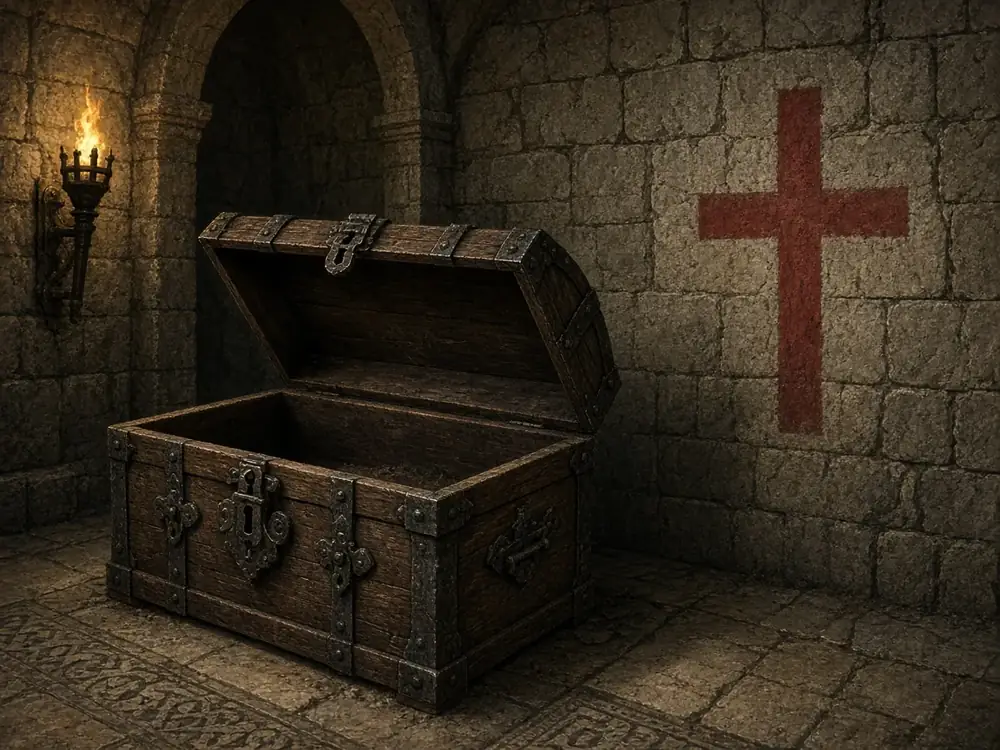
The Knights Templar, a wealthy medieval military order, were arrested in France on Friday, 13 October 1307, and dissolved by the pope in 1312. Legends say their treasure, or relics like the Holy Grail, were hidden before the arrests. No such hoard has ever been found.
Verdict: Unproven. The sources below do not establish this claim. That is not the same as proving it false. How we rate stories
The Story
For nearly two centuries, the Knights Templar were among the most powerful institutions in Europe. Founded to protect Christian pilgrims to the Holy Land, the order grew rich and developed a banking system that issued notes of credit to travelers.
One of its debtors was Philip IV of France. According to the Library of Congress, on Friday, 13 October 1307, his agents arrested hundreds of Templars across France. The pope formally disbanded the order in 1312 during the long investigation into heresy charges, and Philip seized Templar property in his kingdom. The last grand master, Jacques de Molay, was burned at the stake in Paris in March 1314.
The arrests came on a Friday the 13th. The treasure, if there was one, has never turned up.
The suddenness of the fall created a legend: surely the knights had smuggled their wealth away. Over the centuries, believers have placed the 'Templar treasure' at sites such as Rosslyn Chapel in Scotland and Oak Island in Nova Scotia. Some versions say it includes the Holy Grail. None of these claims has been backed by a find.
One real archival twist came in 2007, when the Vatican published the Chinon Parchment. According to the Library of Congress, it shows that some of the order's leading members, including its grand master, had been absolved by the pope's investigators. That changes the story of the Templars' downfall, but not the treasure question. No hoard has ever been found.
Origins
According to the Library of Congress Law Library, King Philip IV of France, who owed the order money, ordered the mass arrests. Pope Clement V dissolved the order in 1312, and its last grand master, Jacques de Molay, was burned at the stake in 1314.
The Claims
- The Templars' treasure was secretly moved before the arrests.
- The order guarded the Holy Grail or other sacred relics.
- The treasure is hidden at a secret site, with places such as Scotland's Rosslyn Chapel and Nova Scotia's Oak Island often named.
Key Evidence
- The arrests of 1307 and the king's debts to the order are documented, according to the Library of Congress.
- In 2007, the Vatican published the Chinon Parchment. NBC News and the AP reported that it shows Clement V initially absolved the Templars' leaders of heresy before he dissolved the order.
The Evidence Against
- No treasure linked to the Templars has been found.
- The documented record, including the Library of Congress account, describes the king seizing Templar property in his kingdom, not a hidden hoard.
Documents & Sources
- Gov DocumentTemplar Secrets at the Law Library of Congress (In Custodia Legis, Library of Congress, September 2011) blogs.loc.gov ↗
- NewsVatican publishes Templar trial documents (NBC News / Associated Press, 2007) nbcnews.com ↗
Each link was checked for availability on Oct. 27, 2026. Links open in a new tab.