Roswell Incident
The belief that a flying saucer crashed near Roswell, New Mexico, in 1947 and that the military recovered alien bodies. Air Force reports in 1994 and 1997 traced the debris to a secret balloon project and the 'bodies' to later test dummies and accidents.
Verdict: Debunked. The weight of the evidence cited below contradicts this claim. How we rate stories
The Story
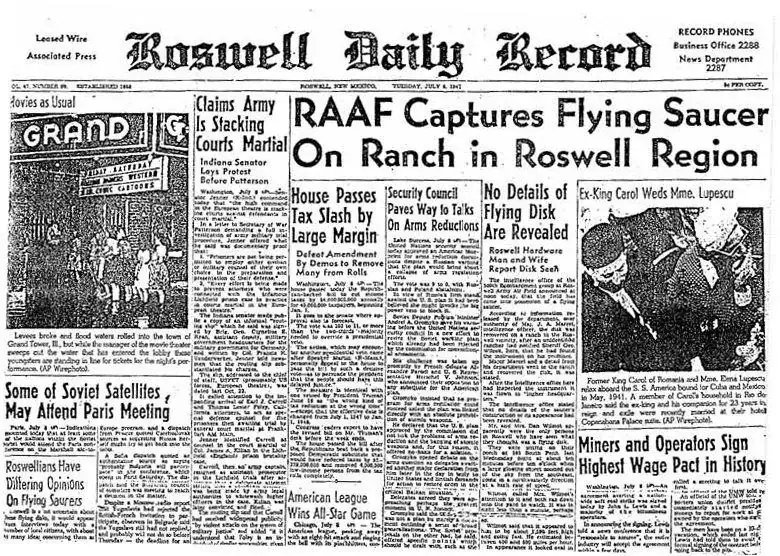
In June 1947, on the Foster Ranch about 75 miles northwest of Roswell, New Mexico, a rancher named W. W. "Mac" Brazel came across a spread of strange wreckage. In an interview published by the Roswell Daily Record on July 9, 1947, he described rubber strips, tinfoil, tough paper and sticks scattered over a wide area. He said there was no sign of any metal that might have come from an engine, and no sign of propellers.
The timing could hardly have been worse, or better, depending on your point of view. That summer the country was gripped by a wave of flying-saucer reports. According to the same newspaper story, Brazel went into town and told Chaves County Sheriff George Wilcox, "kinda confidential like," that he might have found a flying disk. Wilcox contacted Roswell Army Air Field, home of the 509th Bomb Group, and an intelligence officer, Maj. Jesse Marcel, went out to look.
"The object turned out to be a radar tracking balloon." (July 1947 history of the 509th Bomb Group and Roswell Army Air Field, as quoted by the GAO)
On July 8, 1947, the base's public information office announced that its personnel had recovered a "flying disc." The news raced around the world. It lasted about a day. The following day, the press reported that the commanding general of the Eighth Air Force, in Fort Worth, Texas, had announced that the object was a radar-tracking weather balloon. An FBI teletype sent on July 8 said the military had reported an object resembling a high-altitude weather balloon with a radar reflector. The base's own history for July 1947 noted that its information office had been "kept quite busy" with inquiries about the flying disc, and added: "The object turned out to be a radar tracking balloon."
For about three decades, that was the end of it. The Air Force's 1997 report calls the Roswell Incident "essentially a non-story" from 1947 until the late 1970s.
Then the story came back, and it grew. In the late 1970s, UFO researchers began interviewing people connected with the 1947 events, and in 1980 Charles Berlitz and William Moore published the book "The Roswell Incident." According to the 1997 Air Force report, the first claims of alien "bodies" appeared in the late 1970s, with more in the 1980s and 1990s, usually based on secondhand and thirdhand accounts collected as much as 40 years after the event. Over time, witnesses described a second and even a third crash site, a military cordon, and bodies at the base hospital.
In the 1990s, New Mexico Congressman Steven Schiff, concerned that the Defense Department might not have given him all the available information, asked the General Accounting Office, Congress's investigative arm, to find every government record on the crash. That request set two investigations in motion.
The Air Force went first. In July 1994 it reported that the most likely source of the wreckage was a classified project designed to determine the state of Soviet nuclear weapons research. The project was called Mogul. According to the Air Force, it tried to detect Soviet nuclear explosions and ballistic missile launches acoustically, using sensors and radar targets carried on a train of balloons more than 600 feet long. The radar targets were made of aluminized paper on a light balsa-wood frame. The Air Force identified the debris as coming from a Mogul balloon train launched from Alamogordo Army Airfield on June 4, 1947.
The GAO reported in July 1995. Its investigators searched classified and unclassified files from the Army, Air Force, FBI, CIA and National Security Council. They found only two records from 1947 that dealt with the event, the base history and the FBI teletype, and both described a balloon. They also found that some Roswell base records had been destroyed, including administrative records from March 1945 through December 1949 and outgoing messages from October 1946 through December 1949. The paperwork did not show who destroyed them, when, or under what authority. To believers, that gap was telling. The GAO itself did not draw any conclusion from it.
In 1997 the Air Force published a second report, "The Roswell Report: Case Closed," aimed at the stories of alien bodies. It concluded that witnesses were most likely describing Air Force operations that took place years later. From 1953 to 1959, the Air Force dropped human-shaped test dummies from high-altitude balloons over New Mexico to study how pilots could escape at extreme altitudes, and recovery crews went out to collect them. The report said stories of bodies at the base hospital were most likely a combination of two separate events: a 1956 KC-97 crash that killed 11 airmen, and a 1959 balloon mishap that injured two Air Force pilots. Critics pointed out the obvious problem with that explanation: those events happened long after 1947. The Air Force's answer was that the claims, collected decades later, were "a compilation of many verifiable events" from different times, not anything that happened in July 1947.
Roswell's story has outlived every official report. The town has embraced it, and the 1997 Air Force report itself includes a photo of Roswell's International UFO Museum and Research Center. For believers, the case is still the classic crash cover-up. For the government, the documents point to a secret balloon and a mistaken press release.
Origins
On July 8, 1947, the Roswell Army Air Field public information office reported the recovery of a 'flying disc.' The next day the press reported that the commanding general of the Eighth Air Force had identified it as a radar-tracking (weather) balloon. Interest returned in the late 1970s, and the first claims of alien bodies appeared then, according to the Air Force's 1997 report.
The Claims
- An alien craft crashed near Roswell in 1947 and the government covered it up.
- Alien bodies were recovered, and some were taken to the base hospital.
Key Evidence
- The base itself announced a 'flying disc' on July 8, 1947, then the Army called it a balloon the next day.
- The GAO found in 1995 that some Roswell Army Air Field records, including administrative records from March 1945 to December 1949 and outgoing messages from October 1946 to December 1949, had been destroyed, and the paperwork did not show who destroyed them, when, or under what authority.
The Evidence Against
- The Air Force's July 1994 report concluded that the most likely source of the wreckage was Project Mogul, a classified balloon project meant to detect Soviet nuclear tests.
- The 1997 report 'The Roswell Report: Case Closed' linked alien-body stories to anthropomorphic dummies dropped from balloons from 1953 to 1959, and hospital stories to a 1956 KC-97 crash and a 1959 balloon mishap.
- The GAO's 1995 search found two 1947 records, a 509th Bomb Group/base history and an FBI teletype, and both describe a balloon with a radar reflector or radar-tracking balloon.
Documents & Sources
- Gov DocumentOfficial RecordGAO, Results of a Search for Records Concerning the 1947 Crash Near Roswell, New Mexico (NSIAD-95-187, 1995) gao.gov ↗
- Gov DocumentOfficial RecordThe Roswell Report: Case Closed (U.S. Air Force, 1997, PDF) esd.whs.mil ↗
- Gov DocumentOfficial RecordThe Roswell Report (U.S. Air Force) af.mil ↗
- Gov DocumentDeclassified DocumentFBI Vault: Roswell UFO vault.fbi.gov ↗
Each link was checked for availability on Oct. 27, 2026. Links open in a new tab.