Project Azorian: The CIA's Secret Raising of a Soviet Submarine
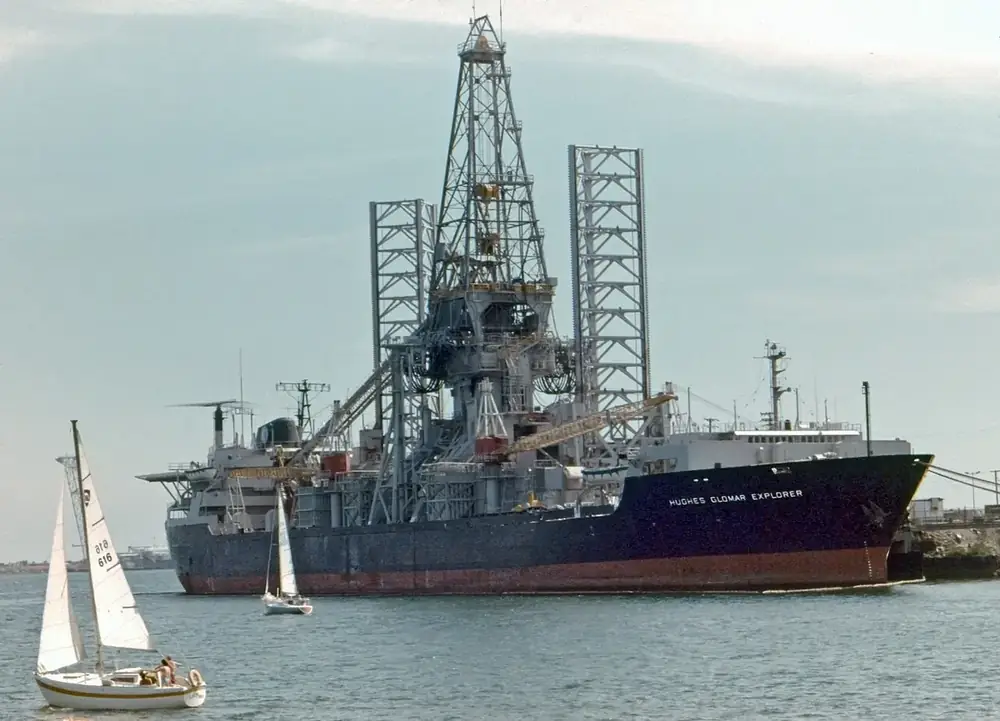
In 1974 the CIA used a specially built ship, the Hughes Glomar Explorer, to raise part of the sunken Soviet submarine K-129 from about three miles down in the Pacific. Publicly, the ship was a deep-sea mining venture linked to billionaire Howard Hughes.
Verdict: Confirmed. This one really happened. The core events are documented in the official records and reporting cited below. How we rate stories
The Story
On March 1, 1968, the Soviet diesel submarine K-129 sailed from the naval base at Petropavlovsk on the Kamchatka Peninsula. According to the National Security Archive, it carried three nuclear-armed ballistic missiles and was headed for a patrol station northeast of Hawaii. In mid-March it suffered a catastrophic accident and sank about 1,560 miles northwest of Hawaii, roughly 16,500 feet down, with its entire crew.
The CIA's own history of what came next is silent on how the United States learned where the wreck lay. Books and articles in the 1970s said the Navy's SOSUS underwater listening network had picked it up, the Archive notes. However it was found, the United States knew where a Soviet missile submarine was lying, and nobody had ever lifted anything that heavy from that deep.
"The team designated to defend the control room long enough to destroy the material... was alerted, but guns were not issued." (CIA history of Project Azorian, on the Soviet ships watching the recovery in July 1974)
The agency decided to try. In July 1969 it set up a Special Projects Staff to run the effort, which carried the codename Project Azorian. That August, CIA Director Richard Helms placed everything about it in a security compartment called "Jennifer." Several 1970s books later reported, wrongly, that Jennifer was the name of the operation itself.
The engineering problem was enormous. By October 1970, CIA engineers and contractors had concluded that the only practical way to raise the roughly 1,750-ton submarine was to lower a specially built recovery system from a large surface ship on a long string of heavy pipe, attach it to the submarine, and raise it with heavy-lift equipment on the ship's deck. According to the Archive's summary of the CIA history, senior officials at first gave the operation only a 10 percent chance of success.
Costs climbed so fast that in August 1971 the project nearly died. It survived, and on November 16, 1971, the keel of the ship was laid at the Sun Shipbuilding yard in Chester, Pennsylvania. To the outside world, the Hughes Glomar Explorer was a deep-sea mining vessel connected to the reclusive billionaire Howard Hughes. Its hull had a huge center well. Under the cover story, the recovery vehicle was a mining device that would be drawn up into it.
The project faced opposition inside the government too. In 1972, with Nixon and Soviet leader Leonid Brezhnev warming relations, the deputy secretary of defense, the chairman of the Joint Chiefs and other senior officials recommended ending it, according to the CIA history as summarized by the Archive. On December 11, 1972, President Nixon ordered it continued. On June 7, 1974, he approved the mission itself, on condition that the ship not start work until he had returned from a summit in Moscow.
The Glomar Explorer reached the site on July 4, 1974, the day after Nixon left Moscow. For almost 14 days it worked under near-continuous watch by two Soviet naval vessels. Worried that the Soviets might try to land a helicopter, the CIA mission director had crates stacked on the ship's helicopter deck on July 18. According to the CIA history, a team was designated to defend the control room long enough to destroy sensitive material if the ship was boarded, but "guns were not issued."
The lift began on August 1. According to the CIA history, the target was brought to the surface on August 8, and the recovery phase was finished on August 9. Once it was aboard, an inspection team found evidence of plutonium. The history says it apparently came mainly from one or more nuclear torpedoes whose high explosive had detonated without causing a nuclear explosion.
How much came up is still partly secret. The declassified history leaves out how much of the submarine was recovered and what intelligence it yielded. According to Sherry Sontag and Christopher Drew's 1998 book "Blind Man's Bluff," the submarine broke apart during the lift, and only a 38-foot forward section was recovered; the missiles and codebooks fell back to the bottom. Seymour Hersh reported in 1975 that senior Navy officials considered the mission a failure because no missiles were recovered. A 1993 report prepared for Russian President Boris Yeltsin concluded that the CIA had recovered at least two nuclear torpedoes. The CIA later gave Yeltsin a videotape of the burial at sea of Soviet crewmen whose bodies were found in the recovered section.
The secret did not hold for long. The Los Angeles Times published the first sketchy details in February 1975, columnist Jack Anderson broadcast the story on March 18, and Hersh's account ran in The New York Times on March 19. After the exposés, when journalist Harriet Ann Phillippi asked under the Freedom of Information Act for CIA records on the agency's efforts to discourage reporting about the project, the agency replied that it could "neither confirm nor deny" its connection to the Glomar Explorer. Phillippi sued, and in 1976 a federal appeals court accepted that the agency could, if it justified it, give that kind of answer. Ever since, a refusal to confirm or deny that records exist has been called a "Glomar response."
In 2010, after a Freedom of Information Act request by the National Security Archive, the CIA released a heavily redacted 50-page article from its in-house journal, Studies in Intelligence, telling the story of the operation for the first time in the agency's own words.
Origins
The Soviet ballistic missile submarine K-129 sank northwest of Hawaii in March 1968. The CIA designed a recovery operation, codenamed Project Azorian, and carried out the lift in August 1974.
The Claims
- The 'mining ship' was really a CIA spy vessel.
- The CIA raised part of a Soviet submarine.
- The government refused to confirm or deny it for decades.
Key Evidence
- In 2010 the CIA declassified a 50-page in-house history of Project Azorian. The National Security Archive published it along with related White House records.
- The history confirms the lift ran from August 1 to August 8, 1974, but it does not say how much of the submarine was recovered. According to the 1998 book "Blind Man's Bluff," only a forward section came up.
- A 1975 Freedom of Information Act request about the ship produced the CIA's "neither confirm nor deny" reply, now known as the "Glomar response."
The Evidence Against
- The operation is confirmed by the CIA's own declassified history. Exactly what was recovered is still partly classified.
Documents & Sources
- AcademicDeclassified DocumentProject Azorian: The CIA's Declassified History of the Glomar Explorer (National Security Archive, Electronic Briefing Book No. 305) nsarchive2.gwu.edu ↗
- Gov DocumentDeclassified Document"Project Azorian: The Story of the Hughes Glomar Explorer," CIA Studies in Intelligence, 1985 (declassified PDF) nsarchive2.gwu.edu ↗
- Gov DocumentDeclassified DocumentProject AZORIAN (CIA Reading Room copy) cia.gov ↗
Each link was checked for availability on Oct. 27, 2026. Links open in a new tab.