The Phoebus Cartel: The Real Lightbulb Conspiracy
In 1924, the world's leading lightbulb makers formed the Phoebus cartel. Among other things, it set a standard life of 1,000 hours for household bulbs, down from the 1,500 to 2,000 hours that had been common, and fined factories whose bulbs lasted longer or shorter than that. It is often cited as an early example of planned obsolescence.
Verdict: Confirmed. This one really happened. The core events are documented in the official records and reporting cited below. How we rate stories
The Story
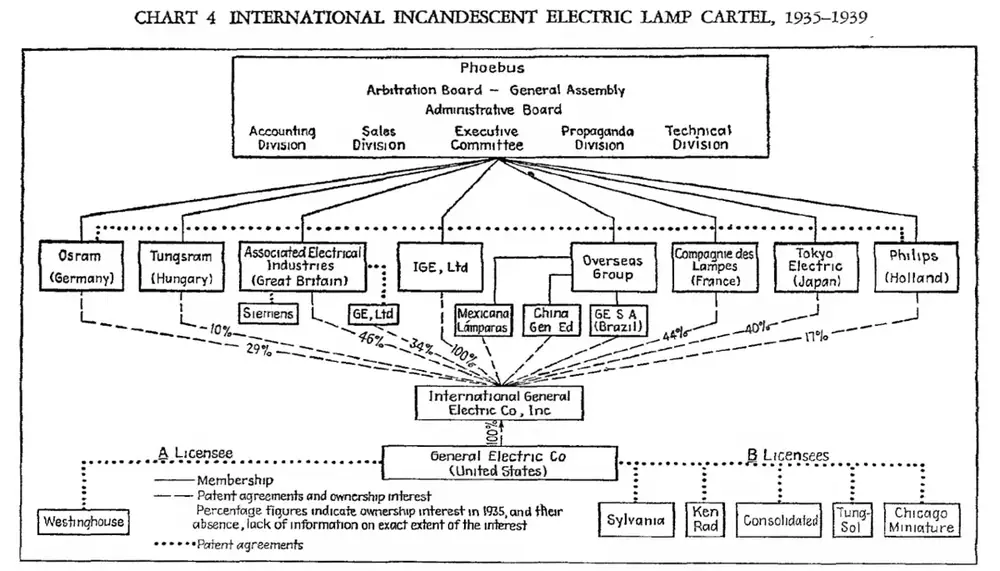
On 23 December 1924, executives from the world's leading lightbulb companies, including Osram, Philips, Compagnie des Lampes and General Electric, met in Geneva. According to historian Markus Krajewski, writing in IEEE Spectrum, they founded the Phoebus cartel to carve up the worldwide market for incandescent bulbs.
Its most lasting effect was on the bulb itself. Krajewski writes that by early 1925 the life of a standard household bulb was set at 1,000 hours, down from the 1,500 to 2,000 hours that had been common. Bulbs were tested at a central laboratory in Switzerland, and any factory whose bulbs lasted longer or shorter than the standard had to pay a fine. In 1927, Tokyo Electric told the cartel that after shortening the lives of its bulbs, its sales had jumped fivefold.
Factories whose bulbs lasted too long had to pay a fine.
Cartel members argued that the trade-off produced better bulbs: higher quality, more efficient and brighter. They also cost a lot more. Krajewski concludes that all evidence points to the cartel being motivated by profits and increased sales, not by what was best for the consumer.
World War II ended the arrangement. Krajewski writes that the 1924 agreement, which was supposed to last until 1955, was nullified in 1940. The Phoebus cartel is now often cited as an early example of planned obsolescence, a suspected corporate conspiracy that turned out to be documented.
Origins
According to historian Markus Krajewski, writing in IEEE Spectrum, representatives of the major lightbulb manufacturers, including Osram, Philips, Compagnie des Lampes and General Electric, met in Geneva on 23 December 1924 and founded the Phoebus cartel.
The Claims
- Lightbulb makers secretly agreed to make bulbs that burn out sooner.
- Companies were punished for making bulbs that lasted too long.
- The cartel's aim was to boost sales.
Key Evidence
- Krajewski writes that by early 1925 the life of a pear-shaped household bulb 'became codified at 1,000 hours,' a 'marked reduction from the 1,500 to 2,000 hours that had previously been common.'
- He writes that bulbs were tested at a central laboratory in Switzerland, and 'if any factory submitted bulbs lasting longer or shorter than the regulated life span for its type, the factory was obliged to pay a fine.'
- In 1927, Krajewski writes, Tokyo Electric told the cartel that after it shortened the lives of its bulbs, its sales had jumped fivefold.
- Krajewski concludes that 'all evidence points to the cartel's being motivated by profits and increased sales, not by what was best for the consumer.'
The Evidence Against
- Krajewski notes that cartel members 'rationalized this approach as a trade-off: Their lightbulbs were of a higher quality, more efficient, and brighter burning than other bulbs.'
- The cartel did not last. Krajewski writes that its agreement, 'which was supposed to last until 1955, was nullified in 1940' during World War II.
Documents & Sources
- AcademicThe Great Lightbulb Conspiracy, Markus Krajewski (IEEE Spectrum, 24 September 2014) spectrum.ieee.org ↗
- NewsThe Phoebus Cartel, Planet Money transcript (NPR) npr.org ↗
- ImagePhoebus cartel structure chart, George W. Stocking and Myron W. Watkins, 1946 (Wikimedia Commons) commons.wikimedia.org ↗
Each link was checked for availability on Oct. 27, 2026. Links open in a new tab.