Operation Popeye: Weather as a Weapon
From 1967 to 1972, the U.S. military secretly seeded clouds over Laos, parts of Vietnam and, in 1972, Cambodia to add rain to the monsoon and turn enemy supply routes on the Ho Chi Minh Trail to mud. The Pentagon described the program to a Senate subcommittee in a Top Secret hearing in March 1974. Its own briefer called the results 'limited and unverifiable.'
Verdict: Confirmed. This one really happened. The core events are documented in the official records and reporting cited below. How we rate stories
The Story
For six monsoon seasons during the Vietnam War, American planes flying out of Thailand carried an unusual payload. They were not dropping bombs. They were dropping flare-like cartridges of silver iodide and lead iodide into the updrafts of clouds, trying to squeeze more rain out of the sky.
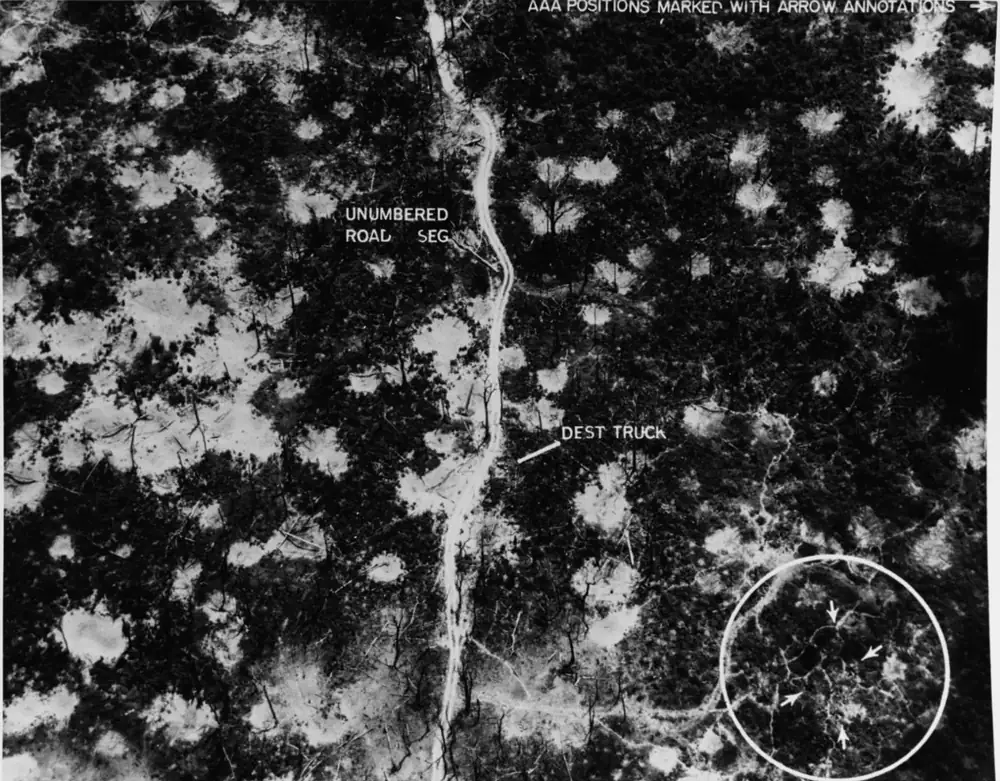
The target was mud. During the southwest monsoon, unpaved roads in Laos turned soggy and could not carry trucks. The Pentagon's goal, as its briefer later explained to the Senate, was "to make difficult the North Vietnamese infiltration through the Laotian panhandle" by softening road surfaces, causing landslides, washing out river crossings and keeping the ground saturated beyond the normal rainy season.
"An 'elephant labored and a mouse came forth.'" (Sen. Claiborne Pell on the secrecy around the program, March 20, 1974)
The idea came from the Pentagon's research office in 1966. A test in the Laos panhandle that October ran 56 seedings, and the military said more than 85 percent of the clouds responded. The Pacific commander concluded that cloud seeding could be "a valuable tactical weapon." The operational phase began on March 20, 1967 and ran each rainy season until the last mission on July 5, 1972. The program had WC-130 weather planes and RF-4C reconnaissance jets assigned to it and cost about $3.6 million a year. Its final tally, according to the Pentagon: 2,602 sorties and 47,409 seeding units.
It was hidden even inside the military. The WC-130 missions were logged and reported through normal channels as ordinary weather reconnaissance flights, while the real results went through special channels to the Joint Chiefs of Staff. When code names leaked, they were changed.
It was hidden from Congress, too. On April 18, 1972, Defense Secretary Melvin Laird told the Senate Foreign Relations Committee: "we have never engaged in that type of activity over North Vietnam." That was not true. According to the Pentagon's own charts, more than a thousand seeding units had been dropped over North Vietnam in 1967 and 1968, before operations there ended on November 1, 1968. In a January 28, 1974 letter, Laird told the committee's chairman that he had "just been informed" of those flights, explained that he had never approved operations over North Vietnam himself, and expressed his regret.
Sen. Claiborne Pell of Rhode Island had been pressing the Pentagon about weather warfare. On March 20, 1974, his subcommittee finally got the full briefing behind closed doors, in a Top Secret session. Pell said it had been the only program the Defense Department had not felt able to discuss with him in either public or private session. After hearing it, he reached for an old saying: an "elephant labored and a mouse came forth." A Pentagon official agreed that the line reflected their current view of the classification. The transcript was made public on May 19, 1974.
Did it work? The briefer said the Defense Intelligence Agency estimated that rainfall was increased in limited areas by up to 30 percent. He also described a sharp drop in detected enemy truck movements in eastern Laos in June 1971, though one of the biggest weekly drops came during a typhoon. In the end, he conceded, the results were "certainly limited and unverifiable," and "program effectiveness cannot be conclusively established." He said the seeding affected probably less than 5 percent of the moisture in the air, could not create large storm systems, and produced less variation than nature itself.
Weather warfare did not stay unregulated. According to the State Department, the Senate had already passed a 1973 resolution calling for an international ban. In 1974, Nixon and Soviet leader Leonid Brezhnev agreed to talks. The result was the Environmental Modification Convention, which banned hostile use of environmental modification techniques with widespread, long-lasting or severe effects. It was signed in Geneva on May 18, 1977 and entered into force on October 5, 1978.
Operation Popeye is often cited by people who believe governments secretly control the weather today. The record supports something smaller: a real, secret attempt to add rain to an existing monsoon, with results that even its own operators could not prove.
Origins
The Pentagon described the program to Sen. Claiborne Pell's Senate Subcommittee on Oceans and International Environment in a Top Secret hearing on March 20, 1974. The transcript was made public on May 19, 1974. At the hearing, Pell referred to the code names Operation Popeye, Intermediary and Compatriot, and a Defense official said they were 'one and the same.'
The Claims
- The U.S. military secretly seeded clouds over Laos and Vietnam to cause extra rain.
- The goal was to turn the Ho Chi Minh Trail to mud and slow North Vietnamese supplies.
- The Defense Secretary's denial to Congress turned out to be wrong.
Key Evidence
- A Defense Department briefing to the subcommittee said 2,602 seeding sorties were flown from March 20, 1967 to July 5, 1972, using 47,409 seeding units, including 1,017 units over North Vietnam in 1967 and 98 in 1968.
- The stated purpose was 'to make difficult the North Vietnamese infiltration through the Laotian panhandle,' by softening road surfaces, causing landslides, washing out river crossings and keeping the soil saturated beyond the normal rainy season.
- Defense Secretary Melvin Laird had told the Senate Foreign Relations Committee on April 18, 1972 that 'we have never engaged in that type of activity over North Vietnam.' In a January 28, 1974 letter he wrote that he had 'just been informed' such activities were conducted there in 1967 and 1968, and expressed regret.
The Evidence Against
- The program's military effect was never proven. The Pentagon's briefer said the results were 'certainly limited and unverifiable' and that 'program effectiveness cannot be conclusively established.'
- It was rainmaking, not weather control. The briefing said the techniques could not create large storm systems, that the seeding affected 'probably less than 5 percent' of the moisture in the air, and that normal year-to-year variation in rainfall was greater than anything the seeding could induce.
Documents & Sources
- Gov DocumentDeclassified DocumentWeather Modification: Hearings before the Senate Subcommittee on Oceans and International Environment, Jan. 25 and Mar. 20, 1974 (GovInfo PDF) govinfo.gov ↗
- Gov DocumentOfficial RecordEnvironmental Modification Convention (ENMOD), U.S. Department of State 2009-2017.state.gov ↗
Each link was checked for availability on Oct. 27, 2026. Links open in a new tab.