Operation Paperclip
After World War II, the U.S. military brought German and Austrian scientists and engineers to the United States, including former Nazi Party members, under a program first code-named Overcast and then Paperclip. The National Archives holds dossiers on over 1,500 of them. Decades later, the Justice Department pursued one of the program's best-known engineers over the use of slave labor.
Verdict: Confirmed. This one really happened. The core events are documented in the official records and reporting cited below. How we rate stories
The Story
As Nazi Germany collapsed in 1945, the United States went looking for its scientists. According to a Justice Department history, as early as July 1945 the War Department was bringing selected German and Austrian scientists to America under military custody for 'short-term exploitation.' The short-term goal was military research to help end the war with Japan. The longer-term goal was to keep the Soviet Union and other countries from getting them.
With the president's direct approval, the program continued after the war. The National Archives says it was run by the Joint Intelligence Objectives Agency, 'initially code-named Overcast and subsequently code-named Paperclip.' On paper there were rules: the program was 'designed to exclude anyone who was more than a "nominal participant" in Nazi party activities or had been an "active supporter of Nazism or militarism."'
NASA's own biography: von Braun 'was involved in decision-making about the use of slave labor.'
Its most famous recruit was Wernher von Braun. NASA's own biography of him is frank: he 'was a member of an SS equestrian unit in 1933-34, joined the Nazi Party in 1937 and became a junior SS officer in 1940.' His team designed the V-2 missile, used against London, Paris and Antwerp from September 1944. V-2s were built at the Mittelwerk, an underground factory near Nordhausen that, NASA says, 'utilized enslaved labor from the attached Mittelbau-Dora concentration camp.' NASA adds that von Braun 'was well aware of the terrible conditions and was involved in decision-making about the use of slave labor.'
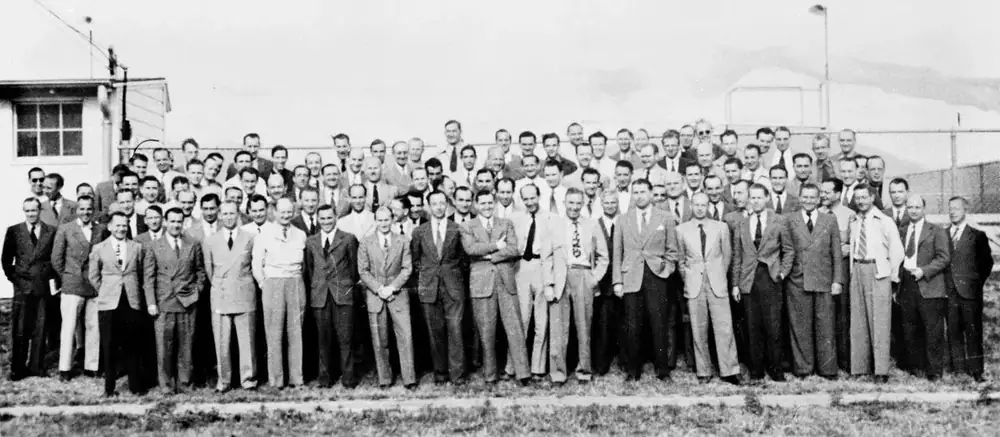
Von Braun surrendered to the Americans. Under Paperclip, he and an initial group of about 125 went to Fort Bliss, Texas, and helped with V-2 launches at White Sands. In 1950 the team moved to Redstone Arsenal near Huntsville, Alabama. A Jupiter C rocket from that team put Explorer I, the first U.S. satellite, into orbit in 1958. Von Braun also appeared in three Walt Disney television programs on space travel.
In 1960 his group moved to the new NASA, and he became director of the Marshall Space Flight Center and, in NASA's words, 'the chief architect of the Saturn V launch vehicle, the superbooster that would propel Americans to the Moon.' He died in 1977.
The National Archives now holds Paperclip dossiers on over 1,500 people. Among them are Georg Rickhey, a Nordhausen factory official who came in 1946 and went back in 1947 to face a U.S. military war crimes trial, where he was acquitted, and Walter Schreiber, who 'had been instrumental in medical experiments on concentration camp inmates' and left for Argentina in 1952. Von Braun's own dossier, the Archives notes, 'was never transferred to NARA.'
The reckoning came for Arthur Rudolph, who had been operations director at the Mittelwerk. He arrived in December 1945, became a citizen in 1954, and stayed in the rocket program until he retired from NASA in 1969. The Justice Department says he 'was considered the father of the Saturn V rocket.' In the early 1980s its Office of Special Investigations looked into his wartime role. Rudolph acknowledged knowing that prisoners were dying of disease, overwork, mistreatment and malnutrition.
Faced with prosecution, Rudolph signed an agreement to leave and renounce his citizenship, and he did not contest allegations that he took part in the persecution of unarmed civilians at Mittelwerk. He left for Germany in October 1984. To the press, he denied wrongdoing, saying he had 'tried to help the poor forced laborers to have their conditions improved.' Germany filed no charges against him. He died there in 1996.
So the core claim holds up: the U.S. knowingly brought in scientists with Nazi pasts, and their wartime records got far more attention decades later than when they arrived.
Origins
According to a 2006 Justice Department history, as early as July 1945 the War Department brought selected German and Austrian scientists to the U.S. for 'short-term exploitation.' The program was extended after the war with the president's direct approval. The National Archives says the Joint Intelligence Objectives Agency (JIOA), set up in 1945 under the Joint Chiefs of Staff, ran the program, 'initially code-named Overcast and subsequently code-named Paperclip.'
The Claims
- The US recruited scientists with Nazi pasts.
- Officials played down or hid their wartime records.
Key Evidence
- The National Archives holds 'personnel dossiers on over 1,500 German and other foreign scientists, technicians, and engineers who were brought to the United States under Project Paperclip and similar programs.'
- NASA's own biography says Wernher von Braun 'joined the Nazi Party in 1937 and became a junior SS officer in 1940,' and that he 'was well aware of the terrible conditions and was involved in decision-making about the use of slave labor' at the Mittelwerk V-2 factory.
- The Justice Department says Arthur Rudolph, Mittelwerk's operations director, signed an agreement to leave the U.S. and renounce his citizenship, and left for Germany in October 1984.
The Evidence Against
- The program and the Nazi pasts of many participants are documented. On paper, the program was 'designed to exclude anyone who was more than a "nominal participant" in Nazi party activities or had been an "active supporter of Nazism or militarism,"' according to the Justice Department history.
- Claims that officials rewrote individual security files come from later books and are not confirmed by the official sources used here, so this entry does not repeat them.
- Rudolph denied wrongdoing to the press after leaving. He was the only Paperclip scientist the Justice Department's Office of Special Investigations prosecuted.
Documents & Sources
- Gov DocumentDeclassified DocumentRecords of the Secretary of Defense (RG 330), JIOA and Paperclip files (National Archives) archives.gov ↗
- Gov DocumentOfficial RecordStriving for Accountability in the Aftermath of the Holocaust (Justice Department, Office of Special Investigations, 2006; released 2010), 'Arthur Rudolph - An Honored Rocket Scientist' justice.gov ↗
- Gov DocumentOfficial RecordWernher von Braun, Former Marshall Space Flight Center Director (NASA) nasa.gov ↗
Each link was checked for availability on Oct. 27, 2026. Links open in a new tab.