Moon Landing Hoax
The claim that NASA faked the Apollo Moon landings (1969 to 1972) on Earth. NASA's records, the lunar samples and later orbital images of the landing sites all contradict it.
Verdict: Debunked. The weight of the evidence cited below contradicts this claim. How we rate stories
The Story
In July 1969, Apollo 11 astronauts Neil A. Armstrong, Michael Collins and Edwin E. 'Buzz' Aldrin completed humanity's first landing on the Moon. A NASA history article recalls the words that marked it: 'Houston, Tranquility Base here, the Eagle has landed,' and 'That's one small step for [a] man, one giant leap for mankind.'
Not everyone believed it. The doubts reached a prime-time audience on February 15, 2001, when Fox television aired 'Conspiracy Theory: Did We Land on the Moon?' According to NASA, guests on the show 'argued that NASA technology in the 1960's wasn't up to the task of a real Moon landing.'
'Setting a camera with the proper exposure for a glaring spacesuit would naturally render background stars too faint to see.' (NASA, 2001)
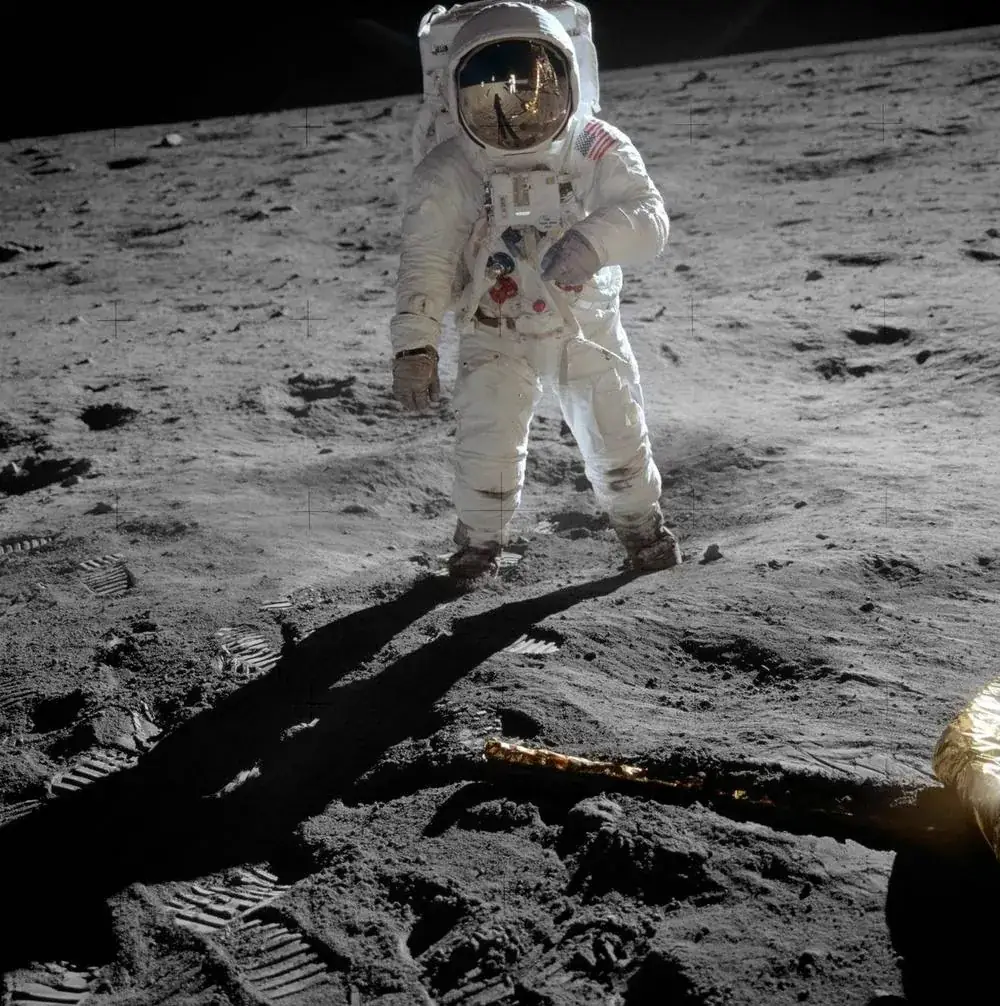
The show leaned on photographs. Why were there no stars in the black lunar sky? NASA answered that it's 'difficult to capture something very bright and something else very dim on the same piece of film,' and that 'Setting a camera with the proper exposure for a glaring spacesuit would naturally render background stars too faint to see.'
Why did the flag seem to ripple with no air to stir it? NASA explained that when the astronauts were planting the flagpole, 'they rotated it back and forth to better penetrate the lunar soil.' So 'of course the flag waved.'
The physical evidence goes beyond photos. According to NASA, between 1969 and 1972 six Apollo missions 'brought back 382 kilograms (842 pounds) of lunar rocks, core samples, pebbles, sand and dust from the lunar surface.' The samples are still studied: 'Nearly 400 samples are distributed each year for research and teaching projects.' In its 2001 rebuttal, NASA quoted lunar geologist Marc Norman: 'lunar samples have almost no water trapped in their crystal structure.'
Then the landing sites were photographed from orbit. NASA's Lunar Reconnaissance Orbiter went into orbit around the Moon in June 2009. In its image of the Apollo 11 site, NASA says, 'The Apollo 11 descent stage, which the astronauts left behind on the lunar surface, is visible, along with the trails made by the astronauts' footprints.' At the Apollo sites more broadly, 'The Lunar modules, astronaut track and various experiment equipments are clearly visible.'
The theory still circulates. The evidence that the landings happened sits in NASA's records, in research labs, and on the Moon itself.
Origins
Doubts circulated for decades and reached a wide audience on February 15, 2001, when Fox television aired a program called 'Conspiracy Theory: Did We Land on the Moon?' NASA published a rebuttal on its science news site eight days later.
The Claims
- The Apollo landings were staged on a film set.
- Photographs show no stars in the lunar sky.
- The flag appears to wave, though there is no air on the Moon.
Key Evidence
- NASA's rebuttal said the Fox program's guests 'argued that NASA technology in the 1960's wasn't up to the task of a real Moon landing.'
- The claims focus on details in Apollo photos and film, such as the missing stars and the moving flag.
The Evidence Against
- On the stars, NASA wrote: 'Setting a camera with the proper exposure for a glaring spacesuit would naturally render background stars too faint to see.'
- On the flag, NASA wrote that when astronauts were planting the flagpole 'they rotated it back and forth to better penetrate the lunar soil,' so 'of course the flag waved.'
- NASA says six Apollo missions 'brought back 382 kilograms (842 pounds) of lunar rocks, core samples, pebbles, sand and dust,' and that 'Nearly 400 samples are distributed each year for research and teaching projects.'
- Images from NASA's Lunar Reconnaissance Orbiter show the Apollo 11 descent stage 'along with the trails made by the astronauts' footprints.'
Documents & Sources
- Gov DocumentOfficial HistoryNASA, '55 Years Ago: Apollo 11's One Small Step, One Giant Leap' (2024) nasa.gov ↗
- Gov DocumentOfficial RebuttalNASA Science, 'The Great Moon Hoax' (February 23, 2001, archived) web.archive.org ↗
- Gov DocumentOfficial RecordNASA Johnson Space Center, Astromaterials Curation: Lunar Rocks and Soils from Apollo Missions curator.jsc.nasa.gov ↗
- Gov DocumentImageryNASA Science, 'Apollo 11 Landing Site' (Lunar Reconnaissance Orbiter image) science.nasa.gov ↗
- Gov DocumentImageryNASA Scientific Visualization Studio, 'Revisiting Apollo Landing Sites' (2019) svs.gsfc.nasa.gov ↗
Each link was checked for availability on Oct. 27, 2026. Links open in a new tab.