Project MKUltra
A real CIA program, approved in 1953, that funded research into drugs such as LSD, hypnosis and other ways to influence behavior. Some tests were done on people who did not know they were being drugged.
Verdict: Confirmed. This one really happened. The core events are documented in the official records and reporting cited below. How we rate stories
The Story
In the early 1950s, American officials were alarmed by reports that communist interrogators could break prisoners' minds, a fear that got a new name: brainwashing. Inside the CIA, the response was a program that would spend the next decade trying to find out whether drugs, hypnosis and other techniques could be used to control human behavior. It was called MKULTRA.
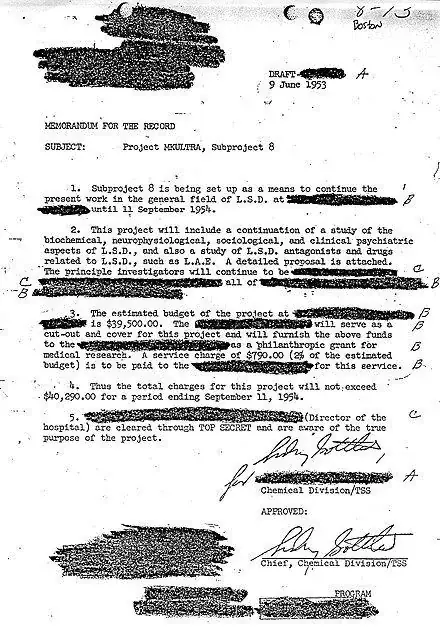
On April 13, 1953, CIA Director Allen Dulles approved the program, along lines proposed by Richard Helms, then a senior officer in the agency's covert operations branch. According to the Church Committee, Dulles noted that security considerations ruled out handling the work through the usual contracts. Normal rules for paperwork and audits were waived. The work was run out of the agency's Technical Services Staff, where the chemist Sidney Gottlieb oversaw it.
"Research in the manipulation of human behavior is considered by many authorities in medicine and related fields to be professionally unethical." (CIA Inspector General's report on MKULTRA, 1963)
The CIA's own inspector general later explained why it was kept so quiet. Research in the manipulation of human behavior, the 1963 report said, "is considered by many authorities in medicine and related fields to be professionally unethical," and some MKULTRA activities "raise questions of legality implicit in the original charter."
Much of the work was farmed out. In 1977, CIA Director Stansfield Turner told the Senate that surviving records covered 149 subprojects and named 185 outside researchers and assistants and 80 institutions, including 44 colleges or universities, 15 research foundations or drug and chemical companies, 12 hospitals or clinics and 3 prisons. The agency often paid through intermediaries, which Turner's statement described as "'cut-out' (i.e., intermediary) funding mechanisms used to conceal CIA's sponsorship." Some researchers did not know who was paying them.
Some of the testing was on people who never agreed to it. In one subproject, the Church Committee found, the person running the test might strike up a conversation with someone in a bar and invite them back to a safe house, where a drug was slipped into a drink or food. Federal narcotics agent George White ran such safe houses in New York and San Francisco for the CIA. Senator Edward Kennedy told the 1977 hearing that some heroin addicts had been enticed into LSD experiments with the promise of heroin as a reward.
The program's most notorious casualty was one of the government's own scientists. On November 19, 1953, at a meeting of Army and CIA scientists in western Maryland, Frank Olson, a civilian Army biochemist, drank a glass of Cointreau into which, the Church Committee found, CIA officer Robert Lashbrook had put about 70 micrograms of LSD as part of an experiment he and Gottlieb were running. Olson soon showed what the committee called symptoms of paranoia and schizophrenia. Days later, while in New York for psychiatric treatment, he fell to his death from a 10th-floor window of the Statler Hotel.
The CIA did not tell his family what had happened. According to the Church Committee, the agency made sure the family received death benefits but did not tell them the circumstances, and worked to keep the death from being connected to the CIA. The truth emerged only in 1975, after the Rockefeller Commission's report. On July 21, 1975, President Gerald Ford met Olson's widow and children in the Oval Office and, in the White House's words, "apologized on behalf of the U.S. Government for the circumstances of Dr. Frank Olson's death." The family has since disputed the official account of how he died.
Inside the agency, doubts grew. The inspector general's 1963 review noted that the people running the unwitting tests "are not qualified scientific observers" and that some subjects had become ill for hours or days. The domestic unwitting testing was suspended after that review. Gottlieb himself, testifying in secret in 1975, said that when everything was added up, "it was probably not a high pay-off program."
Then came the cleanup. In early 1973, as both men were preparing to leave, Gottlieb asked Helms, by then CIA director, for permission to destroy the MKULTRA files, and Helms agreed. According to Helms's account quoted by the Church Committee, Gottlieb told him "he was retiring and that I was retiring and he thought it would be a good idea if these files were destroyed."
For a while that seemed to be the end of it. Kennedy told the 1977 hearing that no one, "not the Director of the CIA, who ordered the documents destroyed, not the official responsible for the program, nor any of his associates," could be found who remembered the details. Then, as Kennedy put it, one individual's Freedom of Information Act request spurred the agency to search again. In 1977 the CIA reported finding seven boxes of MKULTRA documents, mostly financial records that had been stored separately and escaped destruction.
Those papers were the basis of an August 3, 1977, joint Senate hearing and are now public. They show a program that was real, large and in parts reckless, but they do not show a working mind-control technique. Because most of the original files were destroyed, the full list of people who were tested, and what was done to each of them, is still unknown.
Origins
CIA Director Allen Dulles approved MKULTRA on April 13, 1953, amid Cold War fears of communist 'brainwashing.' Chemist Sidney Gottlieb oversaw the work.
The Claims
- The CIA secretly gave people LSD and other drugs.
- The program ran through universities, hospitals and prisons, often through intermediaries that hid the CIA's role.
- Records were deliberately destroyed.
Key Evidence
- The Church Committee reported in 1976 that most MKULTRA documents were destroyed in early 1973 on the order of CIA Director Richard Helms.
- In 1977 the CIA found seven boxes of surviving documents. CIA Director Stansfield Turner told the Senate they covered 149 subprojects and named 80 institutions, including 44 colleges or universities and 3 prisons.
- Frank Olson, an Army scientist, died in 1953 days after the CIA secretly gave him LSD. President Ford apologized to his family in 1975.
Documents & Sources
- Gov DocumentOfficial RecordProject MKULTRA, the CIA's Program of Research in Behavioral Modification: joint Senate hearing, August 3, 1977 (includes Church Committee excerpts; via Internet Archive) web.archive.org ↗
- Gov DocumentOfficial RecordChurch Committee overview (U.S. Senate) senate.gov ↗
- Gov DocumentOfficial RecordWhite House press secretary statement on meeting with the Olson family, July 21, 1975 (Ford Library) fordlibrarymuseum.gov ↗
- AcademicDeclassified DocumentThe Top Secret Testimony of CIA's MKULTRA Chief, 50 Years Later (National Security Archive, 2025) nsarchive.gwu.edu ↗
Each link was checked for availability on Oct. 27, 2026. Links open in a new tab.