Was the Lusitania Set Up to Be Sunk?
A long-running theory says British leaders, Winston Churchill in particular, deliberately left the liner Lusitania exposed to a U-boat to draw the United States into World War I. The ship did carry war materiel, and British officials played that down. But historians cited here say no evidence of a deliberate plan has been produced.
Verdict: Unproven. The sources below do not establish this claim. That is not the same as proving it false. How we rate stories
The Story
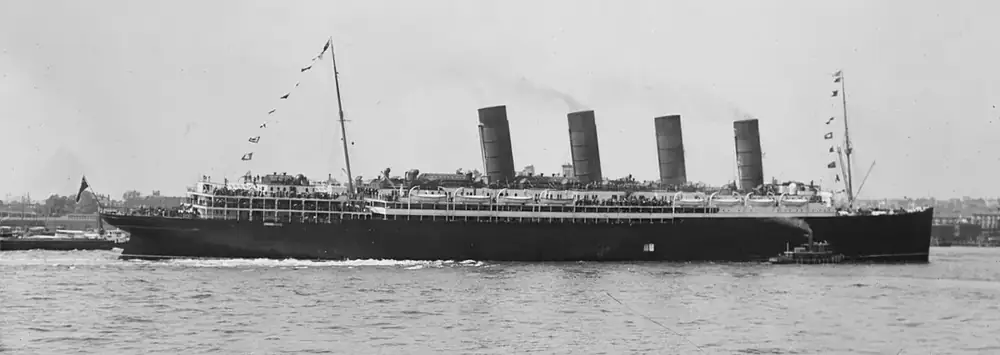
On 7 May 1915 the German submarine U-20 torpedoed the Cunard liner Lusitania off the coast of Ireland without warning. The Imperial War Museums says it sank in 18 minutes, killing 1,200 of almost 2,000 people aboard, 128 of them American citizens. The BBC gives the death toll as 1,198.
Germany had declared a war zone around Britain that February, in which shipping would be sunk on sight. The outrage in the United States was immense, and so, later, was the suspicion: had Britain let it happen? The Churchill Project says political opponents made that claim against Churchill in the 1930s, and that a 1972 book by Colin Simpson revived it, arguing the liner had been left without an escort.
'No evidence has ever been presented to support the theory.' — historian Thomas A. Bailey, as quoted by the Churchill Project
Some pieces are true. The ship carried British war materiel, and British authorities played down the munitions at the official inquiry. In 1982 a Foreign Office official, according to files reported by the BBC, still worried that the subject 'may yet - literally - blow up on us.' And in 1937 Churchill wrote that he regarded the sinking 'as an event most important and favorable to the Allies.'
Three days after the sinking, Churchill told the Commons that the Admiralty could not escort passenger ships, and that it had sent the Lusitania warnings and directions about her course, which were acknowledged.
The central claim, a deliberate plan to sacrifice the ship, is where the documents run out. The Churchill Project says the Admiralty war diary Simpson quoted has never been found by any historian, and it quotes historian Thomas A. Bailey: 'No evidence has ever been presented to support the theory.' The United States did not enter the war until April 1917, according to the Imperial War Museums. The story has real secrets about the cargo, and a plot that no one has documented.
Origins
According to the Churchill Project at Hillsdale College, 'In the 1930s, political opponents anxious to discredit Churchill's warnings about Hitler claimed he had purposely endangered Lusitania.' The Project says author Colin Simpson revived the idea in 1972.
The Claims
- The Admiralty deliberately withheld protection from the Lusitania.
- The ship secretly carried munitions, making it a target.
- Britain wanted American deaths to bring the U.S. into the war.
Key Evidence
- The ship carried war materiel. The Imperial War Museums says it kept operating as a passenger liner 'despite being used to carry British war materiel.' Smithsonian, reviewing historian Diana Preston's book, says she 'does present evidence that the liner was transporting munitions and weapons' and that British authorities played this down at the official inquiry.
- The ship was unescorted. In the House of Commons on 10 May 1915, Churchill said 'the resources at our disposal do not enable us to supply destroyer escort for merchant or passenger ships, more than 200 of which, on the average, arrive or depart safely every day.'
- According to the BBC, files released by the National Archives show a Foreign Office official in 1982 feared the cargo 'subject may yet - literally - blow up on us.'
- Smithsonian quotes Churchill writing in 1937 that he regarded 'the sinking of the Lusitania as an event most important and favorable to the Allies.'
The Evidence Against
- The Churchill Project quotes historian Thomas A. Bailey: 'No evidence has ever been presented to support the theory.' It says Lusitania historian David Ramsay, writing in 2004, quoted historians Stephen Roskill and David Stafford as 'at one in rejecting any conspiracy, by Churchill or anyone else.'
- The Churchill Project says the 'Admiralty War Diary' Simpson quoted 'appears nowhere else in Simpson's book, not even the bibliography. No historian has found it.'
- Churchill told the Commons that the Admiralty 'sent warnings to the "Lusitania," and directions as to her course,' and that both messages were acknowledged.
- Smithsonian says a technical study commissioned by Preston found the ship sank in 18 minutes 'because the torpedo struck it just below the bridge, causing catastrophic structural failure.'
- The Imperial War Museums notes that the sinking 'did not immediately bring the United States into the war.'
Documents & Sources
- Official RecordThe Sinking Of RMS Lusitania During The First World War (Imperial War Museums) iwm.org.uk ↗
- Gov DocumentOfficial RecordDestruction of Steamship "Lusitania." Statement by Mr. Churchill, House of Commons, 10 May 1915 (Hansard) api.parliament.uk ↗
- NewsTorpedoed! (Smithsonian Magazine) smithsonianmag.com ↗
- NewsFiles show confusion over Lusitania sinking account (BBC News) bbc.com ↗
- Academic'Churchill Sank the Lusitania to Get America into the War' (The Churchill Project, Hillsdale College) winstonchurchill.hillsdale.edu ↗
Each link was checked for availability on Oct. 27, 2026. Links open in a new tab.