Hollow Earth: Worlds Beneath Our Feet
The idea that Earth is hollow, open at the poles and perhaps inhabited inside, goes back centuries and once had serious supporters. Measurements of Earth's density, and the study of earthquake waves, show that the planet is solid with a dense core.
Verdict: Debunked. The weight of the evidence cited below contradicts this claim. How we rate stories
The Story
One of the earliest serious proponents of a hollow Earth was Edmond Halley, the astronomer best known for his comet. In 1692 the Royal Society's Philosophical Transactions published his paper on why the compass needle's variation changes over time. He proposed concentric shells around a core with its own north and south poles. If the core rotated at a different speed from the exterior, he argued, that would explain the changes compass readings showed.
Halley was evidently proud of the model. A 1736 portrait shows him holding a diagram of it. But the Royal Society's archivist notes that the 1774 Schiehallion experiment, which determined the planet's density, 'conclusively disproved any hollow Earth theory.'
'I declare the earth is hollow and habitable within.' (John Cleves Symmes Jr., 1818)
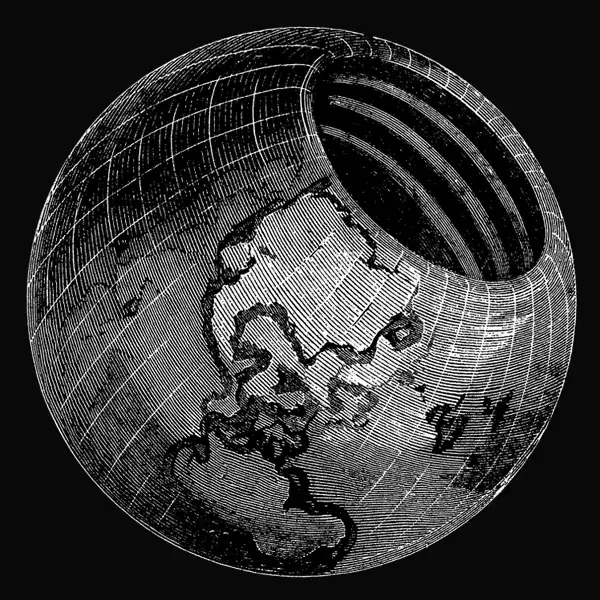
The idea took a more adventurous turn in America. On 10 April 1818, John Cleves Symmes Jr., an army officer who fought in the War of 1812, issued a single-page circular: 'I declare the earth is hollow and habitable within; containing a number of solid [concentric] spheres, one within the other, and that it is open at the poles 12 or 16 degrees.' He asked for 'one hundred brave companions' to set out from Siberia with reindeer and sleighs.
Symmes lectured for years, and the newspaper editor Jeremiah N. Reynolds joined him on the circuit. In his diary on 4 November 1826, President John Quincy Adams wrote that the theory had been 'so much ridiculed, and is in truth so visionary,' that Reynolds had turned instead to proposing a voyage to the Southern Ocean. Symmes never got his expedition.
The interior of the Earth was eventually mapped through earthquakes. APS News explains that S-waves cannot pass through liquid. In 1926 Harold Jeffreys concluded from this that Earth has a liquid core. P-waves were then detected where his model said they should not reach. In September 1936, Inge Lehmann proposed a solid inner core inside the liquid one.
Halley's idea was a reasonable hypothesis given the evidence of his day. The evidence since then shows a solid, layered planet.
Origins
In 1692 the astronomer Edmond Halley published a model of Earth with concentric shells around a core, to explain why magnetic north is not fixed. On 10 April 1818, the American army officer John Cleves Symmes Jr. issued a circular declaring Earth 'hollow and habitable within.'
The Claims
- Earth is hollow, with openings at the poles.
- The interior is habitable.
Key Evidence
- Halley put the idea forward in the Royal Society's Philosophical Transactions as a scientific hypothesis to explain the changing magnetic needle.
- Symmes lectured for years. According to the Smithsonian, he and Jeremiah Reynolds spoke in sold-out halls.
The Evidence Against
- The Royal Society's archivist writes that the 1774 Schiehallion experiment, which determined the planet's density, 'conclusively disproved any hollow Earth theory.'
- Seismology later mapped the interior. Earthquake waves revealed a liquid core, and in 1936 Danish seismologist Inge Lehmann proposed that Earth has a solid inner core.
Documents & Sources
- OfficialMagnetic Halley (Royal Society, 16 October 2023) royalsociety.org ↗
- Analysis10 April 1818: John Cleves Symmes's 'No. 1 Circular' (BRANCH) branchcollective.org ↗
- NewsJohn Quincy Adams Was an Ardent Supporter of Exploration (Smithsonian Magazine) smithsonianmag.com ↗
- AnalysisSeptember 1936: Seismologist Inge Lehmann Concludes That Earth Has an Inner Core (APS News) aps.org ↗
Each link was checked for availability on Oct. 27, 2026. Links open in a new tab.