Gulf of Tonkin Incident
The second reported attack on U.S. destroyers in the Gulf of Tonkin on August 4, 1964, which President Johnson cited when he ordered airstrikes and asked Congress for war powers, did not happen, according to a declassified National Security Agency history. That history says signals intelligence was presented in a way that supported the claim of an attack.
Verdict: Confirmed. This one really happened. The core events are documented in the official records and reporting cited below. How we rate stories
The Story
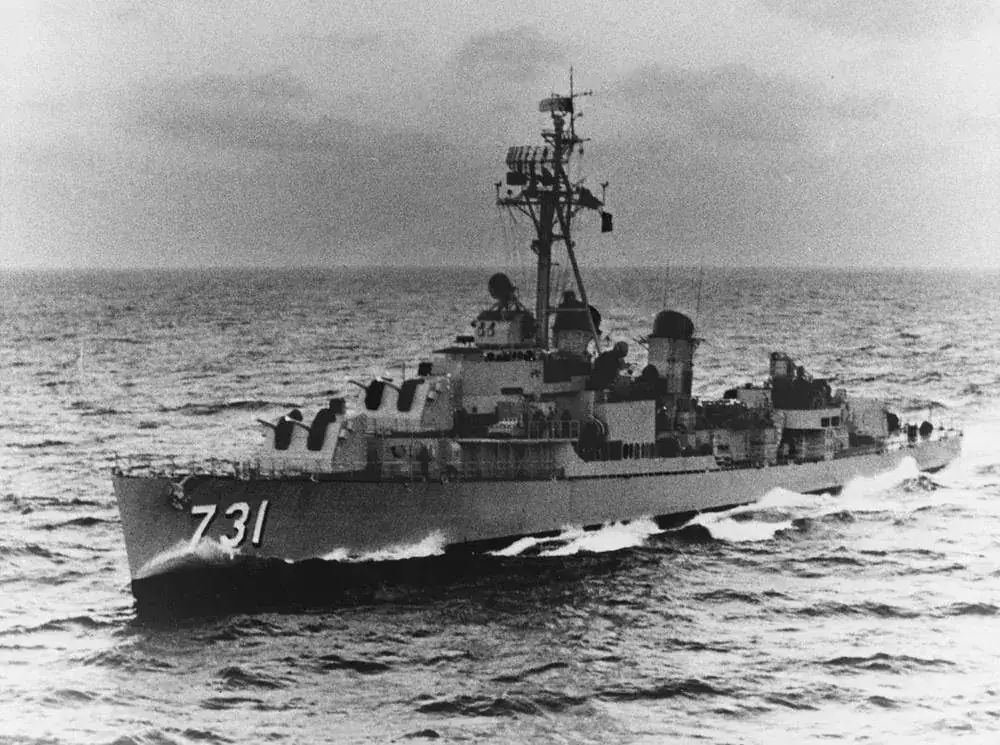
On the afternoon of August 2, 1964, the destroyer USS Maddox was in the Gulf of Tonkin, off the coast of North Vietnam, on an intelligence-gathering cruise known as a Desoto patrol. Three North Vietnamese P-4 torpedo boats came at it. According to the National Security Agency's own later history of the incident, the Maddox fired three rounds to warn them off, a detail the Johnson administration never reported, since it insisted the Vietnamese had fired first. Jets from the carrier Ticonderoga joined the fight. When it was over, one torpedo boat was left dead in the water and the other two were damaged. The Maddox was unscathed except for a single bullet hole from a machine-gun round.
That first clash was real, and it had a backstory the public did not hear at the time. Under a covert Defense Department program called OPLAN 34A, South Vietnamese commandos had been raiding the North Vietnamese coast. In the nights just before the Maddox fight, commando boats had attacked islands in the gulf, including Hon Me. The NSA history says those raids, together with the Maddox's presence nearby, set off the confrontation. Publicly, Defense Secretary Robert McNamara assured the Senate there was no connection between what the Navy was doing and any South Vietnamese operations.
"It is not simply that there is a different story as to what happened; it is that no attack happened that night." (NSA historian Robert J. Hanyok)
Two nights later, on August 4, the Maddox and a second destroyer, the USS Turner Joy, were back in the gulf. The weather was bad, with heavy swells and low clouds. The ships' radars showed fast-moving contacts, sonar operators reported torpedoes, and for hours the destroyers maneuvered and fired at targets they could barely see. James Stockdale, a Navy pilot flying overhead that night, later wrote that he saw "no boats, no boat wakes, no ricochets off boats, no boat impacts, no torpedo wakes - nothing but black sea and American firepower."
The on-scene commander, Capt. John J. Herrick, began to doubt what had happened. Hours after the incident, according to the NSA history, he radioed the Pacific command that he was doubtful of many aspects of the "attack." That afternoon in Washington, the Pentagon got word that "a review of the action makes many reported contacts and torpedoes fired 'appear doubtful'" because of freak weather, over-eager sonar operators and the absence of visual sightings. But in Washington, intercepted North Vietnamese radio messages had reached top officials, and they were read as proof of an attack.
That night, President Lyndon Johnson went on radio and television. "The initial attack on the destroyer Maddox, on August 2, was repeated today by a number of hostile vessels attacking two U.S. destroyers with torpedoes," he said. "That reply is being given as I speak to you tonight." American planes were striking North Vietnamese torpedo boat bases and supporting facilities. Johnson also said he would ask Congress for a resolution.
He got it within three days. On August 7, the House passed the Gulf of Tonkin Resolution 416 to 0, and the Senate passed it 88 to 2. The only no votes came from Senators Wayne Morse of Oregon and Ernest Gruening of Alaska. The resolution approved the president's determination "to take all necessary measures to repel any armed attack against the forces of the United States and to prevent further aggression." Johnson, and later President Richard Nixon, relied on it as the legal basis for their military policies in Vietnam. At the height of American involvement, more than half a million U.S. troops were stationed there.
Doubts lingered. In 1968, the Senate Foreign Relations Committee, chaired by J. William Fulbright, the senator who had steered the resolution through the Senate, held hearings on the incident. McNamara testified that the supporting signals intelligence was "unimpeachable." Congress later repealed the resolution, and according to the National Archives the repeal came in January 1971.
The fullest answer came from inside the agency whose intercepts had mattered most. NSA historian Robert J. Hanyok wrote a top-secret study for the agency's internal journal, Cryptologic Quarterly, in its Winter 2000/Spring 2001 issue, titled "Skunks, Bogies, Silent Hounds, and the Flying Fish: The Gulf of Tonkin Mystery, 2-4 August 1964." His conclusion was blunt: "it is not simply that there is a different story as to what happened; it is that no attack happened that night." On August 4, he wrote, North Vietnam's navy was engaged in nothing but the salvage of two of the boats damaged on August 2.
Hanyok also examined how the NSA had handled the evidence. He found that nearly 90 percent of the relevant signals intelligence was left out of the agency's summary reports and its October 1964 chronology, and that what was issued beginning late on August 4 "was deliberately skewed to support the notion that there had been an attack." For years, he wrote, that chronology was the source NSA used to answer congressional inquiries. But he also stated that the mishandling "was not done in a manner that can be construed as conspiratorial, that is, with manufactured evidence and collusion at all levels." In his view, the people involved were trying to support the Navy's claim of an attack.
The NSA released Hanyok's study in 2005, along with a large collection of related documents. By then, the core question had an official answer. Whether the officials who rushed to retaliate in 1964 knowingly misled the country, or convinced themselves of something that never happened, is still debated by historians.
Origins
On August 2, 1964, North Vietnamese torpedo boats attacked the destroyer USS Maddox. On August 4 the Maddox and USS Turner Joy reported a second attack. Johnson ordered retaliatory airstrikes that night, and Congress passed the Gulf of Tonkin Resolution on August 7.
The Claims
- The August 4 attack never took place.
- Intelligence was presented in a way that made the attack look certain, helping the administration win broad war powers from Congress.
Key Evidence
- NSA historian Robert J. Hanyok's study, written for the agency's classified Cryptologic Quarterly (Winter 2000/Spring 2001) and released in 2005, concluded that "no attack happened that night."
- Hanyok found that nearly 90 percent of the relevant signals intelligence was left out of NSA's post-attack summary reports and its October 1964 chronology.
- Hours after the incident, the on-scene commander radioed that he was doubtful of many aspects of the attack, citing freak weather, over-eager sonar operators and no visual sightings.
The Evidence Against
- The August 2 attack was real. North Vietnamese boats attacked the Maddox, which was hit by a single machine-gun bullet.
- Hanyok wrote that the mishandling of the intelligence was not done in a manner that can be construed as conspiratorial, with manufactured evidence and collusion at all levels. Officials who believed an attack occurred may not have been lying.
Documents & Sources
- Gov DocumentDeclassified DocumentHanyok, "Skunks, Bogies, Silent Hounds, and the Flying Fish" (NSA, PDF) nsa.gov ↗
- Gov DocumentOfficial RecordTonkin Gulf Resolution (National Archives) archives.gov ↗
- Gov DocumentOfficial RecordJohnson's radio and television report, August 4, 1964 (American Presidency Project) presidency.ucsb.edu ↗
- News"Resolution Wins; Senate Vote Is 88 to 2 After House Adopts Measure, 416-0" (New York Times, Aug. 8, 1964) nytimes.com ↗
- AcademicGulf of Tonkin documents (National Security Archive) nsarchive2.gwu.edu ↗
Each link was checked for availability on Oct. 27, 2026. Links open in a new tab.