Operation Gladio: NATO's Secret 'Stay-Behind' Armies
In 1990 Italy's prime minister disclosed that a secret, armed 'stay-behind' network code-named Gladio had existed for decades to resist a possible Soviet invasion, and other Western European governments acknowledged similar networks. The European Parliament condemned them. Claims that the networks were behind terrorist attacks remain unproven in the official record cited here.
Verdict: Partly True. Part of this story is documented in the sources below. Other parts of the popular theory are not supported by them. How we rate stories
The Story
For much of the Cold War, Western European governments planned for a Soviet invasion. One answer, made public in 1990, was a set of secret 'stay-behind' networks: civilians trained and armed to fight behind the lines of an occupying army.
In November 1990 Italian Prime Minister Giulio Andreotti disclosed Italy's network, code-named Gladio after the short Roman sword. According to The New York Times, he said it began as an Italian creation and later became part of a network 'operated within NATO and abetted by a 1956 agreement between the United States and Italian secret services.' Over the years, he said, 622 Italians had belonged to it.
Of 12 missing arms caches, the Times wrote: 'Their disappearance has fueled speculation here that the weapons ended up in terrorist hands.'
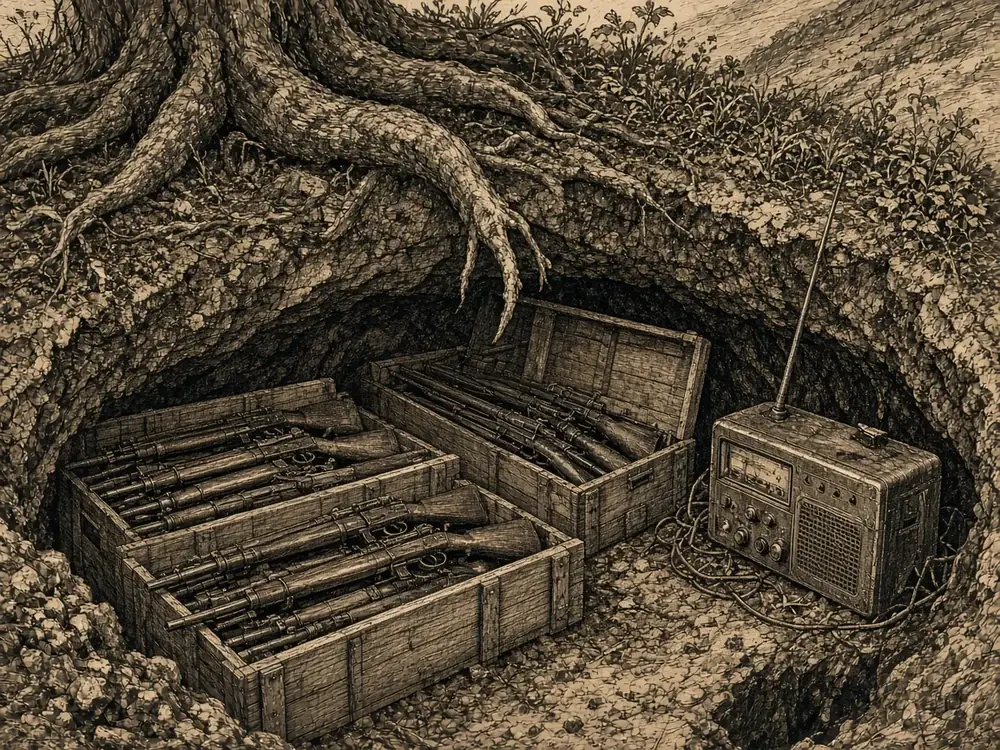
The members had hidden stockpiles of weapons. The Times reported that Andreotti said the arms deposits were dismantled as far back as 1972, 'but that the secret services could not find 12 of them.' The paper added: 'Their disappearance has fueled speculation here that the weapons ended up in terrorist hands.'
Other governments followed. The Times reported that Germany, France, Belgium, the Netherlands, Greece and Luxembourg 'have all acknowledged that they maintained Gladio-style networks.' Some officials said they had been kept in the dark. Former NATO Secretary General Joseph Luns said he had never heard of it.
On 22 November 1990 the European Parliament condemned 'the clandestine creation of manipulative and operational networks' and called on member states 'to dismantle all clandestine military and paramilitary networks.' Its resolution said the organization had 'escaped all democratic controls' for over 40 years. It also noted that in some member states, military secret services or branches of them had been involved in serious terrorism and crime, 'as evidenced by, various judicial inquiries,' and asked for full investigations, including into any links with terrorist groups.
That is where the darker theory begins: that stay-behind members were tied to the bombings that hit Italy from 1969 into the 1980s. The Italian intelligence chief at the time, Adm. Fulvio Martini, testified that 'Not one of the 622 was ever involved in any conspiracies or plots.' The documents cited here establish that a secret armed network existed, was coordinated with NATO, and was hidden from the public for decades. They do not establish that it carried out attacks.
Origins
The New York Times reported on 16 November 1990 that Prime Minister Giulio Andreotti had disclosed the network, which he said had evolved into a branch of a network 'operated within NATO and abetted by a 1956 agreement between the United States and Italian secret services.' Italy's Parliament had opened an inquiry the same day.
The Claims
- NATO countries secretly built armed underground networks to resist a Soviet occupation.
- These networks kept hidden weapons caches.
- Stay-behind members carried out or helped cover up terrorist bombings to sway politics.
Key Evidence
- According to the Times, Andreotti said 622 Italians had belonged to the operation over the years, and that secret arms deposits were dismantled in 1972 'but that the secret services could not find 12 of them.'
- The Times reported that Germany, France, Belgium, the Netherlands, Greece and Luxembourg 'have all acknowledged that they maintained Gladio-style networks.'
- On 22 November 1990 the European Parliament adopted a resolution citing 'a clandestine parallel intelligence and armed operations organization' run 'by the secret services of the states concerned in collaboration with NATO.' It called on member states 'to dismantle all clandestine military and paramilitary networks.'
- The resolution also stated that in certain member states, military secret services 'or uncontrolled branches thereof' were involved in serious cases of terrorism and crime 'as evidenced by, various judicial inquiries.' It did not name Gladio members as the perpetrators, and called for investigations.
The Evidence Against
- The network's existence is confirmed. A direct role in terrorist attacks is not established by the sources cited here. The Times said the 12 missing caches had 'fueled speculation' that weapons reached terrorists.
- Italy's chief of military intelligence, Adm. Fulvio Martini, testified that Gladio had no ties to right-wing groups. 'Not one of the 622 was ever involved in any conspiracies or plots,' he told the parliamentary commission, according to the Times.
Documents & Sources
- Gov DocumentOfficial RecordEuropean Parliament resolution on Gladio, 22 November 1990, OJ C 324/201 (text via Wikisource) en.wikisource.org ↗
- NewsEvolution in Europe; Italy Discloses Its Web Of Cold War Guerrillas, Clyde Haberman (The New York Times, 16 November 1990, archived) web.archive.org ↗
Each link was checked for availability on Oct. 27, 2026. Links open in a new tab.