Flat Earth
The belief that the Earth is a flat disc, not a globe, and that scientists and governments are hiding the truth.
Verdict: Debunked. The weight of the evidence cited below contradicts this claim. How we rate stories
The Story
Samuel Rowbotham was a devout Christian from Manchester, born in the 19th century. According to research by Camay Chapman-Cameron of the March and District Museum, reported by the BBC, he 'hated the discoveries of Newton.' He went to the Old Bedford River in the Fens, a six-mile stretch of straight, flat water, to prove the Earth was flat.
He sent a boat with a flag on its mast along the river and watched it through a telescope. He said he could see it all the way to Welney Bridge, six miles away, and took this as proof. According to Chapman-Cameron, he repeated the experiment five times over the next 30 years and got the same result each time. He lectured widely, and in 1865 he published 'Earth not a Globe.'
Wallace won the argument at the canal in 1870. According to the BBC, he 'never received a penny' of the wager money.
Rowbotham was arguing against at least 2,500 years of acceptance that the Earth is a globe. Live Science notes that the ancient Greeks worked out its shape and even its circumference in the third century B.C. Chapman-Cameron calls the popular story that Columbus's crew feared sailing off the edge 'completely false.' She traces it to Washington Irving's 1828 biography of Columbus.
John Hampden took up Rowbotham's cause and offered £500 to anyone who could prove the theory wrong. On 5 March 1870 he met the naturalist Alfred Russel Wallace, co-discoverer of evolution by natural selection, at the Old Bedford River. Two referees were present. The BBC reports that Wallace proved the Earth's curvature, but that Hampden rejected the result and refused to pay. Lawsuits, libel cases, periods in prison and death threats followed. In Chapman-Cameron's words, Wallace 'never received a penny of the wager money.'
The idea survived. The Smithsonian reports that Samuel Shenton founded the Flat Earth Society in the 1950s, and Live Science gives the year as 1956. After Shenton's death in 1972, Charles K. Johnson became president, and membership grew to about 3,500. In 1980 Johnson told Science Digest: 'You can't orbit a flat earth.' By the time he died, membership had fallen to about 100.
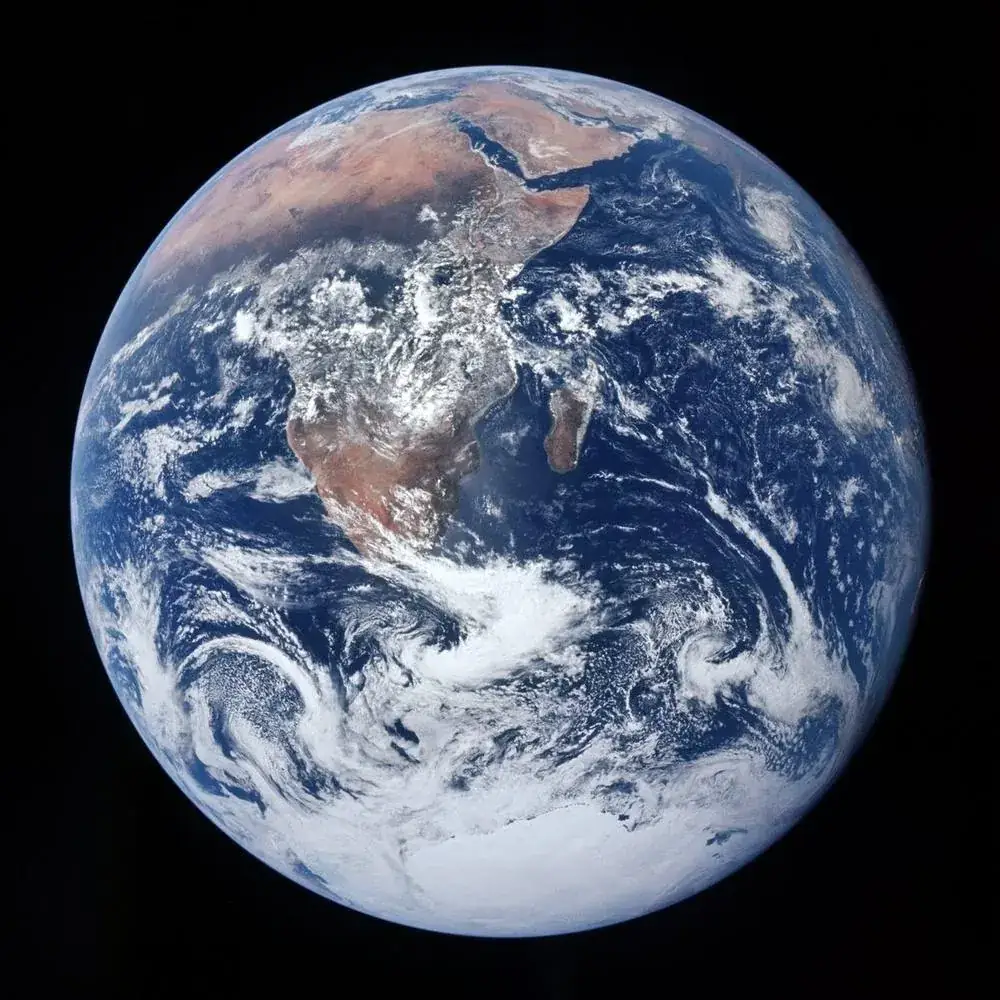
In 1972 the Apollo 17 crew photographed the whole Earth on their way to the moon. NASA's 'Blue Marble' image shows the planet from the Mediterranean to the South polar ice cap.
The idea revived online in the 2010s. Live Science says the leading flat-earth model shows a disc with the Arctic at the centre and Antarctica as an ice wall around the rim. In January 2016 the rapper B.o.B posted a photo on Twitter and asked, 'where is the curve?' Flat Earth International Conferences have been held in the United States. A 2017 Public Policy Polling survey, cited by Live Science, found that only 1% of Americans believed the Earth was flat, and another 6% said they were not sure.
The evidence for a globe is plain to see. Earth's shadow on the moon during an eclipse is curved, and the stars visible from the Northern and Southern Hemispheres are different.
Origins
The modern movement goes back to Samuel Rowbotham's Bedford Level experiments in the Fens and his 1865 book 'Earth not a Globe'. In the 20th century it was carried on by the Flat Earth Society. It grew again online in the 2010s.
The Claims
- The Earth is a disc with the Arctic at its centre and Antarctica as a wall of ice around the rim.
- NASA and other space agencies fake their evidence.
- Water does not curve over long distances.
Key Evidence
- Rowbotham said that, looking through a telescope, he could see a flagged boat for the whole six miles of the Old Bedford River to Welney Bridge.
- Believers point to everyday views where the horizon looks flat.
The Evidence Against
- Live Science notes that the ancient Greeks worked out the planet's shape, and even its circumference, in the third century B.C. Eratosthenes did it by comparing the angles of shadows in two cities.
- During lunar eclipses, Earth's shadow on the moon is curved. The constellations seen from the Northern and Southern Hemispheres are also different.
- In 1870, at the Old Bedford River, Alfred Russel Wallace showed that the water's surface curves. According to the BBC's account, Wallace took refraction into account.
- NASA's 1972 'Blue Marble' photograph, taken by the Apollo 17 crew, shows the Earth from the Mediterranean to the South polar ice cap.
Documents & Sources
- NewsThe Fens and the flat Earth conspiracy (BBC) bbc.com ↗
- NewsThe Curious History of The International Flat Earth Society (Smithsonian, 29 January 2016) smithsonianmag.com ↗
- NewsFlat Earth 'theory': Why do some people think the Earth is flat? (Live Science) livescience.com ↗
- OfficialBlue Marble: Image of the Earth from Apollo 17 (NASA) nasa.gov ↗
Each link was checked for availability on Oct. 27, 2026. Links open in a new tab.