The Dyatlov Pass Incident
In February 1959, nine experienced hikers died in the northern Ural Mountains after cutting their way out of their tent at night. The Soviet investigation blamed 'a compelling natural force.' Russian authorities and a 2021 scientific study have since pointed to an avalanche, but relatives, members of the public and researchers still dispute it.
Verdict: Unproven. The sources below do not establish this claim. That is not the same as proving it false. How we rate stories
The Story
In February 1959, nine experienced ski hikers died on a mountain in the northern Urals of the Soviet Union. Their leader was Igor Dyatlov, and the pass where it happened now bears his name. The 2021 study says the mountain's name means 'Dead Mountain' in the local Mansi language.
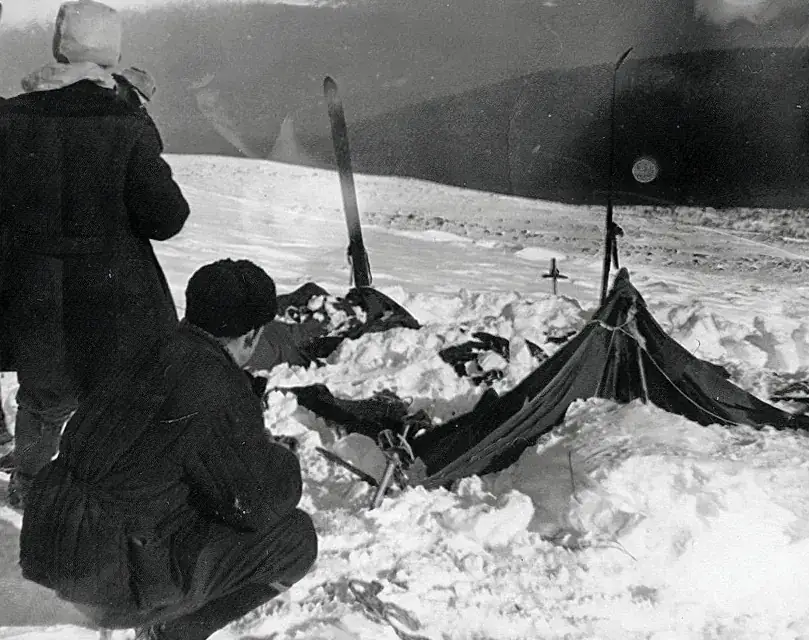
Something happened after midnight that made them cut their tent open from the inside. They fled toward a forest more than 1 km downslope, without appropriate clothes, in temperatures below −25 °C and strong winds.
The Soviet investigation blamed 'a compelling natural force,' but never identified it.
Search teams found the broken tent 26 days later. Over the following three months they found the bodies, in the forest and on the way back to the tent. Hypothermia was found to be the main cause of death. But four hikers had severe chest or skull injuries, two were missing eyes and one was missing her tongue. Traces of radioactivity were found on some clothes, and glowing orange spheres were reported in the sky that night.
The 1959 Soviet investigation concluded that 'a compelling natural force' had caused the deaths, but did not identify it. Theories multiplied over the years: an attack by fugitives or by local Mansi people, a fight among the hikers, secret weapons, and more.
An avalanche was proposed early on, but it faced four objections. The search team saw no obvious signs of an avalanche. The slope above the tent was gentler than 30 degrees. Any avalanche would have struck at least nine hours after the group cut into the slope for the tent. And the injuries were not typical of avalanche victims.
In 2015, Russia's Investigative Committee reopened the case. In 2019 it concluded that a snow avalanche was the most probable cause. The Prosecutor General's Office began its own inquiry in 2019 and reached the same conclusion in July 2020. '[The dead tourists'] injuries are characteristic for the injuries of rock climbers caught in an avalanche,' Andrei Kuryakov of the prosecutor's office told reporters.
In 2021, Johan Gaume and Alexander Puzrin proposed a specific mechanism. The cut in the slope, combined with wind-blown snow piling up above the tent, could have triggered a small, delayed slab avalanche. The authors said they did not address other puzzles, such as the radioactivity or the hikers' behavior after leaving the tent. The study notes that the official conclusions continue to be challenged by relatives, the public and researchers. A 2019 Swedish-Russian expedition, for example, blamed katabatic winds instead.
Origins
The group, named after its leader Igor Dyatlov, was on a difficult ski expedition. Search teams found the abandoned tent 26 days later. The bodies were found over the next three months.
The Claims
- The hikers were killed by a secret military or weapons test.
- They were attacked by people or by an unknown creature.
- Something unexplained drove them from their tent.
Key Evidence
- According to the 2021 study, the hikers cut the tent open from the inside and fled more than 1 km downslope in temperatures below −25 °C, without appropriate clothes.
- The same study notes that four had severe chest or skull injuries, two were missing eyes and one was missing her tongue. Traces of radioactivity were found on some clothing, and glowing orange spheres were reported in the sky that night.
The Evidence Against
- Russia's Investigative Committee reopened the case in 2015 and in 2019 concluded that a snow avalanche was the most probable cause. The Prosecutor General's Office reached the same conclusion in July 2020.
- A 2021 study in Communications Earth & Environment proposed a mechanism for a small, delayed slab avalanche consistent with the injuries.
- According to both the 2021 study and the prosecutors, most of the hikers died of hypothermia.
Documents & Sources
- StudyMechanisms of slab avalanche release and impact in the Dyatlov Pass incident in 1959 (Communications Earth & Environment, 2021) nature.com ↗
- NewsProsecutors say avalanche killed Dyatlov group in Urals in 1959 (TASS, 11 July 2020) tass.com ↗
Each link was checked for availability on Oct. 27, 2026. Links open in a new tab.