D.B. Cooper: The Hijacker Who Parachuted Into Legend
On 24 November 1971, a man who called himself Dan Cooper hijacked a Northwest Orient flight, collected $200,000 in ransom in Seattle and parachuted out over the Pacific Northwest at night. He was never found. The FBI suspended its active investigation in 2016.
Verdict: Unproven. The sources below do not establish this claim. That is not the same as proving it false. How we rate stories
The Story
On the afternoon of 24 November 1971, the day before Thanksgiving, a man at Portland's airport paid cash for a one-way ticket on Northwest Orient Flight 305 to Seattle. He gave his name as Dan Cooper. The FBI describes him as a quiet man who appeared to be in his mid-40s, in a business suit, white shirt and black tie, carrying a cheap attaché case. He ordered a bourbon and soda while the plane waited to take off. A flight attendant later told the FBI that the jet left Portland at 2:53 p.m. and lifted off at 2:58 p.m. on a route that normally took 36 minutes.
Cooper sat in seat 18E, near the back. Shortly after 3 p.m., according to the FBI, he handed a flight attendant a note saying he had a bomb. Accounts of the note's exact wording differ. One flight attendant who read it told the FBI that, to the best of her recollection, it said: "Miss, I am hijacking this plane. I have a bomb. Sit next to me." A flight attendant then called the cockpit on the interphone: "We're being hijacked, he's got a bomb and this is no joke," according to that interview report.
"No experienced parachutist would have jumped in the pitch-black night, in the rain, with a 200-mile-an-hour wind in his face, wearing loafers and a trench coat." (FBI Special Agent Larry Carr, 2007)
The attendant who sat beside him described what he showed her next. According to her FBI interview, he opened "a black cheap appearing imitation leather attache case." Inside were eight red cylinders and a wire running to a large battery. The wire was bare for its last inch, and he held that end between his fingers. The FBI's summary calls it "a mass of wires and red colored sticks." His demands, the FBI says, were $200,000 in twenty-dollar bills and four parachutes. In her account, he also wanted fuel trucks waiting in Seattle.
For the rest of the flight to Seattle, she relayed his messages to the cockpit, and her interview report preserves what he said. When she brought up the idea that they would be going to Cuba, he laughed and said they weren't, but that she would like where they were going. When she asked where he was from, he "became upset" and refused to say. When she asked why he had chosen Northwest, "he laughed and said, 'It's not because I have a grudge against your airlines, it's just because I have a grudge.'" He then said the flight suited his time, place and plans. He offered her a cigarette. She had quit, the report says, but she took it and smoked it.
The details in that report are specific. When a passenger came back looking for a sports magazine, the hijacker told her, "If that is a Sky Marshal I don't want any more of that." She told him there were no sky marshals on the flight. He asked for his note back. He also asked for the empty matchbook he had tossed into a seat pocket. As the jet held in a pattern near Seattle, he remarked that it was 5:15 and he had wanted everything by 5 p.m. The plane landed at Seattle International Airport at 5:46 p.m., the report says, almost three hours after leaving Portland.
Seattle First National Bank supplied the cash, a bag weighing about 19 pounds, and recorded the serial numbers on microfilm before Cooper received it, according to HistoryLink. The attendant dragged the white canvas money bag down the aisle to him. Once he had looked through it, he let the 36 passengers go. She then made several trips to bring the parachutes aboard. He cut cord from one parachute and wrapped it around the neck of the money bag, the report says, and he refused the paper of jumping instructions she offered. He let the other two flight attendants leave.
He then gave his orders, as recorded in her interview: "We're going to Mexico City, gear down, flaps down," with flaps trimmed to 15, altitude under 10,000 feet, the rear door open and the stairs down, cabin lights out, and everyone forward of the first-class curtain. He would allow refueling anywhere in Mexico, he said, but nowhere in the United States. When refueling dragged on for more than an hour, he grew agitated. When she mentioned filing a flight plan, he said, "Never mind, they can do that over the radio once we get up. Let's get the show on the road."
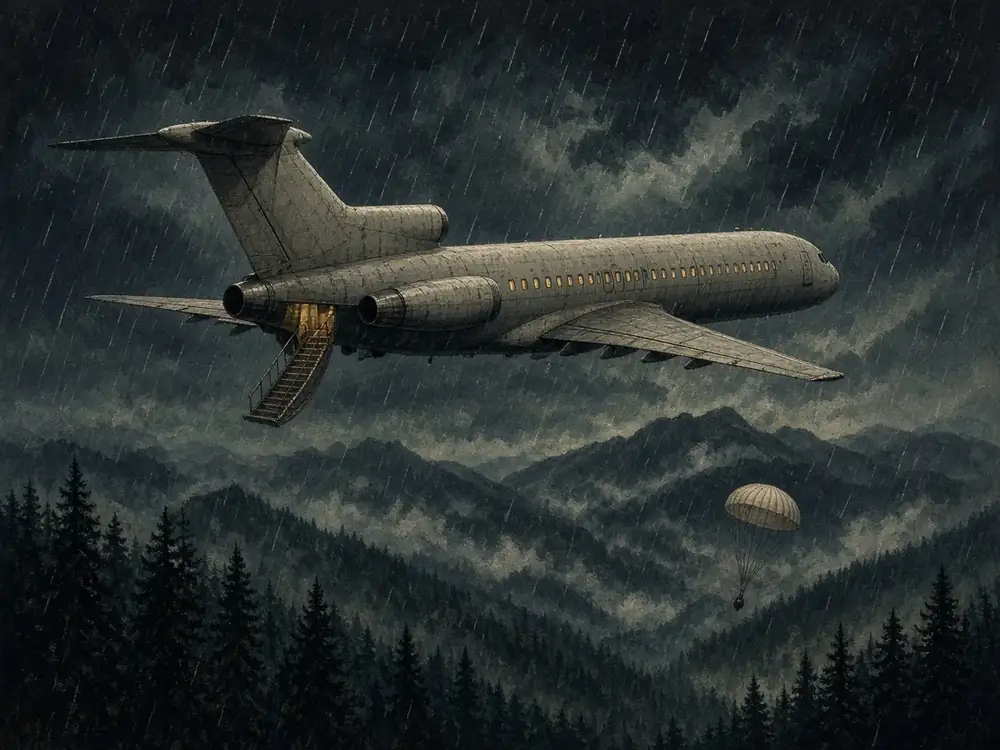
While the plane taxied, the report says, she showed him where the controls for the rear stairs were. About four minutes after takeoff he told her to go to the cockpit and keep everyone behind the curtain. The last time she saw him, he was standing in the darkened aisle with a nylon cord tied around his waist. She pleaded with him to take the bomb with him. He said he would take it or disarm it before he left. About ten minutes later, he called the cockpit to say he could not get the stairs down. Soon after, a red light showed that they were lowered. A few minutes later came his last call. The FBI says he jumped "somewhere between Seattle and Reno, a little after 8:00 p.m."
The weather was poor. A 2007 FBI article describes "driving wind and rain" and cloud cover at 5,000 feet. The attendant told agents the weather was "extremely murky" and that the ground could not be seen. When the plane landed in Reno, the captain called to the hijacker a number of times and got no answer. She switched on all the cabin lights, and there was no one there. She saw two parachutes left behind, one of them cut open. The FBI says he took two parachutes with him, one of them a training reserve that had been sewn shut. He also left a black J.C. Penney tie, which he had removed before jumping. It later yielded a DNA sample, according to the FBI.
The investigation was code-named NORJAK. By the fifth anniversary, the FBI says, it had considered more than 800 suspects and ruled out all but about two dozen. The FBI calls the name "D.B." "a myth created by the press." Richard Floyd McCoy carried out a similar hijacking months later. The FBI says he was ruled out because he did not match the flight attendants' descriptions. Books and documentaries have named other suspects over the years, but none has been confirmed. This entry does not name living people.
Then, on Sunday, 10 February 1980, the case got its first new clue. Eight-year-old Brian Ingram was smoothing sand for a campfire on Tena Bar, on the Washington side of the Columbia River, when he uncovered three deteriorating packets of twenty-dollar bills, according to HistoryLink. An FBI teletype from that month, which redacts the family's names, says the money was "barely held together by decomposed rubber-bands which crumbled and fell away upon being handled." The same teletype records that a relative later told the FBI the story of who found it was "not entirely accurate." The serial numbers matched the ransom: $5,800 in all, the FBI says.
In 2007 the case agent, Larry Carr, told the FBI's website that Cooper "probably never even got his chute open." In 2016 the FBI redirected the case's resources to other priorities. Only a small part of the money "has ever surfaced," the FBI said in 2007. Every one of those serial numbers was on microfilm before Cooper ever touched the bag.
Origins
According to the FBI, the man bought a ticket in cash in Portland, Oregon, for Flight 305 to Seattle. Shortly after 3 p.m., he told a flight attendant he had a bomb in his briefcase.
The Claims
- Cooper survived the jump and got away with the money.
- Cooper was one of several suspects named in books and documentaries over the years.
- He died in the jump, and the FBI cannot prove it.
Key Evidence
- The FBI says Cooper exchanged the 36 passengers for the money and four parachutes in Seattle. The plane took off again toward Mexico City, and he jumped from the rear somewhere between Seattle and Reno a little after 8 p.m.
- In 1980, a boy found $5,800 in decaying $20 bills that matched the ransom serial numbers, according to the FBI.
- The FBI says it considered more than 800 suspects in the first five years. It later obtained a DNA sample from the black tie Cooper removed before jumping.
The Evidence Against
- The FBI says Cooper may not have survived. His parachute could not be steered, his clothing was unsuitable, and he jumped at night into wooded terrain.
- According to the FBI, Richard Floyd McCoy, who carried out a similar hijacking months later, was ruled out because he did not match the flight attendants' descriptions. Other suspects named in books and on TV have not been confirmed.
- The name 'D.B.' was a press error, according to the FBI. The hijacker called himself Dan Cooper.
Documents & Sources
- Gov DocumentD.B. Cooper Hijacking (FBI, Famous Cases and Criminals) fbi.gov ↗
- Gov DocumentD.B. Cooper Redux: Help Us Solve the Enduring Mystery (FBI, 2007) fbi.gov ↗
- Gov DocumentDeclassified DocumentFBI FD-302 interview of the flight attendant who sat with the hijacker, 3 Dec 1971 (FBI Vault, D.B. Cooper Part 64, PDF pp. 159-166) vault.fbi.gov ↗
- Gov DocumentDeclassified DocumentFBI Records: The Vault, D.B. Cooper case files vault.fbi.gov ↗
- Gov DocumentDeclassified DocumentFBI Portland teletype on the 1980 ransom-money find, 20 Feb 1980 (FBI Vault, D.B. Cooper Part 96, PDF pp. 302-304) vault.fbi.gov ↗
- News$5,800 of D. B. Cooper's ransom money is found near the Columbia River (HistoryLink) historylink.org ↗
Each link was checked for availability on Oct. 27, 2026. Links open in a new tab.