The Church Committee and the CIA's Poison Dart Gun
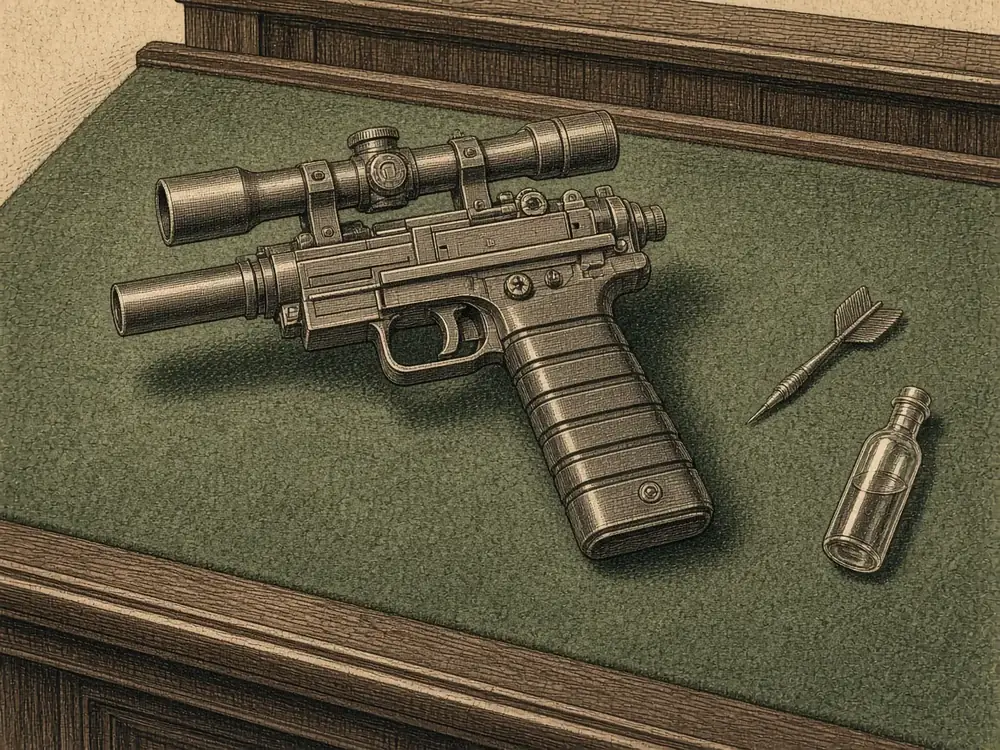
In September 1975, the Senate's Church Committee opened its first public hearings with a case of CIA employees keeping a deadly shellfish toxin after the president had ordered it destroyed. CIA Director William Colby brought along an electric pistol built to fire tiny poison darts. The weapon is now popularly called the 'heart attack gun,' though that name does not appear in the hearings.
Verdict: Partly True. Part of this story is documented in the sources below. Other parts of the popular theory are not supported by them. How we rate stories
The Story
On the morning of September 16, 1975, the Senate's new intelligence committee held its first public hearing in room 318 of the Russell Senate Office Building. Its chairman, Sen. Frank Church of Idaho, had spent months on secret testimony about CIA assassination plots. For its public debut, the committee chose a case in which, as Church put it, "direct orders of the President of the United States were evidently disobeyed by employees of the CIA."
The story came from the CIA's own director, William Colby. He testified that from 1952 to 1970, the agency had worked with the Army's Special Operations Division at Fort Detrick, Maryland, on biological agents, toxins and ways to deliver them in secret. In November 1969, President Nixon renounced biological warfare, and on February 14, 1970, the White House announced he had ordered toxin stocks destroyed unless they were needed for defensive research. Then, in May 1975, an internal search turned up about 11 grams of shellfish toxin, a little less than half an ounce, and a small amount of cobra venom in a little-used vaulted storeroom in a CIA building.
"As a murder instrument, that is about as efficient as you can get, is it not?" "It is a weapon, a very serious weapon." (Sen. Frank Church and CIA Director William Colby, September 16, 1975)
How did it get there? Colby said a retired branch chief had explained that the toxin was so costly and difficult to produce that destroying it "simply made no sense." According to Colby, both that officer and his successor agreed that no one, including their immediate superior, had been told the toxin was kept. Colby also said that Richard Helms, who had led the CIA in 1970, recalled giving clear instructions that the agency's stockpile be destroyed.
Church wanted the room to understand the scale. He said CIA official Carl Duckett had told the committee that if that amount of toxin were taken by mouth, it was enough to kill at least 14,000 people, and that estimates for more efficient methods ran into the hundreds of thousands. Colby conceded that when the CIA kept that amount, "it obviously did it improperly."
Then came the show-and-tell. Church asked whether Colby had brought some of the devices. "We have, indeed," Colby said. He described a pistol that looked like an ordinary .45 but ran on a battery in the handle and fired a small dart. Its range? "One hundred meters, I believe." A special dart, he said, had been developed that "potentially would be able to enter the target without perception." Church pressed further: wasn't the aim that neither the dart nor the toxin would be found in an autopsy? Colby said there had been an attempt so that "there was no way of perceiving that the target was hit." When Church called it about as efficient a murder instrument as you can get, Colby replied: "It is a weapon, a very serious weapon."
The paperwork was just as vivid. A 1967 CIA project memo listed work on a "nondiscernible microbioinoculator" for clandestine and imperceptible inoculation. Colby said the agency had also spent a great deal of effort on knocking out guard dogs, and that the toxin's only known operational use was in the U-2 flight over the Soviet Union in May 1960. Pilot Francis Gary Powers carried a silver dollar hiding a tiny drill bit whose grooves were filled with the toxin, but he did not use it and was not told to.
This is where the internet legend of the "heart attack gun" begins. That nickname does not appear in the hearing record. Colby testified that lethal materials had been prepared for one operation, which was not carried out, and that otherwise "no record can be found that these materials or devices were used for lethal operational purposes." Nothing in the official record shows the gun killed anyone.
The hearing helped launch a much larger reckoning. The committee's final report, issued April 29, 1976, made 96 recommendations. According to the Senate Historical Office, its work led to a permanent Senate intelligence committee and helped shape the Foreign Intelligence Surveillance Act of 1978.
Origins
The Senate Select Committee to Study Governmental Operations with Respect to Intelligence Activities, chaired by Sen. Frank Church of Idaho, was set up in 1975 to investigate abuses by U.S. intelligence agencies. Its first public hearings, on September 16, 17 and 18, 1975, examined the CIA's unauthorized storage of toxic agents.
The Claims
- The CIA built a gun that could kill with an undetectable poison dart, leaving the death looking natural.
- The agency kept biological toxins after being ordered to destroy them.
- Such weapons were used on real targets.
Key Evidence
- Colby testified that about 11 grams of shellfish toxin and a small amount of cobra venom had been found in a little-used CIA storeroom in 1975, five years after President Nixon's February 14, 1970 order to destroy toxin stocks not needed for defensive research. Church said CIA official Carl Duckett had told the committee the toxin was enough to kill at least 14,000 people if taken by mouth.
- Colby showed the committee an electric pistol that fired a small dart. Asked its range, he said: 'One hundred meters, I believe.' He agreed that there had been an attempt to make sure 'there was no way of perceiving that the target was hit.'
- A 1967 CIA project approval memo, read into the record, listed work on a 'nondiscernible microbioinoculator,' which Colby described as 'a dart device for clandestine and imperceptible inoculation with biological warfare or chemical warfare agents.'
The Evidence Against
- Colby testified that 'no record can be found that these materials or devices were used for lethal operational purposes.' He said lethal materials had been prepared for one operation that was not carried out. No evidence in the official record shows the dart gun was used on anyone.
- The phrase 'heart attack gun' is a popular nickname. It does not appear in the hearing record cited here.
Documents & Sources
- Gov DocumentOfficial RecordIntelligence Activities, Volume 1: Unauthorized Storage of Toxic Agents (Senate Select Committee hearings, September 16-18, 1975; archived PDF) web.archive.org ↗
- Gov DocumentOfficial RecordThe Church Committee (U.S. Senate Historical Office) senate.gov ↗
Each link was checked for availability on Oct. 27, 2026. Links open in a new tab.