The Business Plot: A General's Testimony About a Fascist Coup
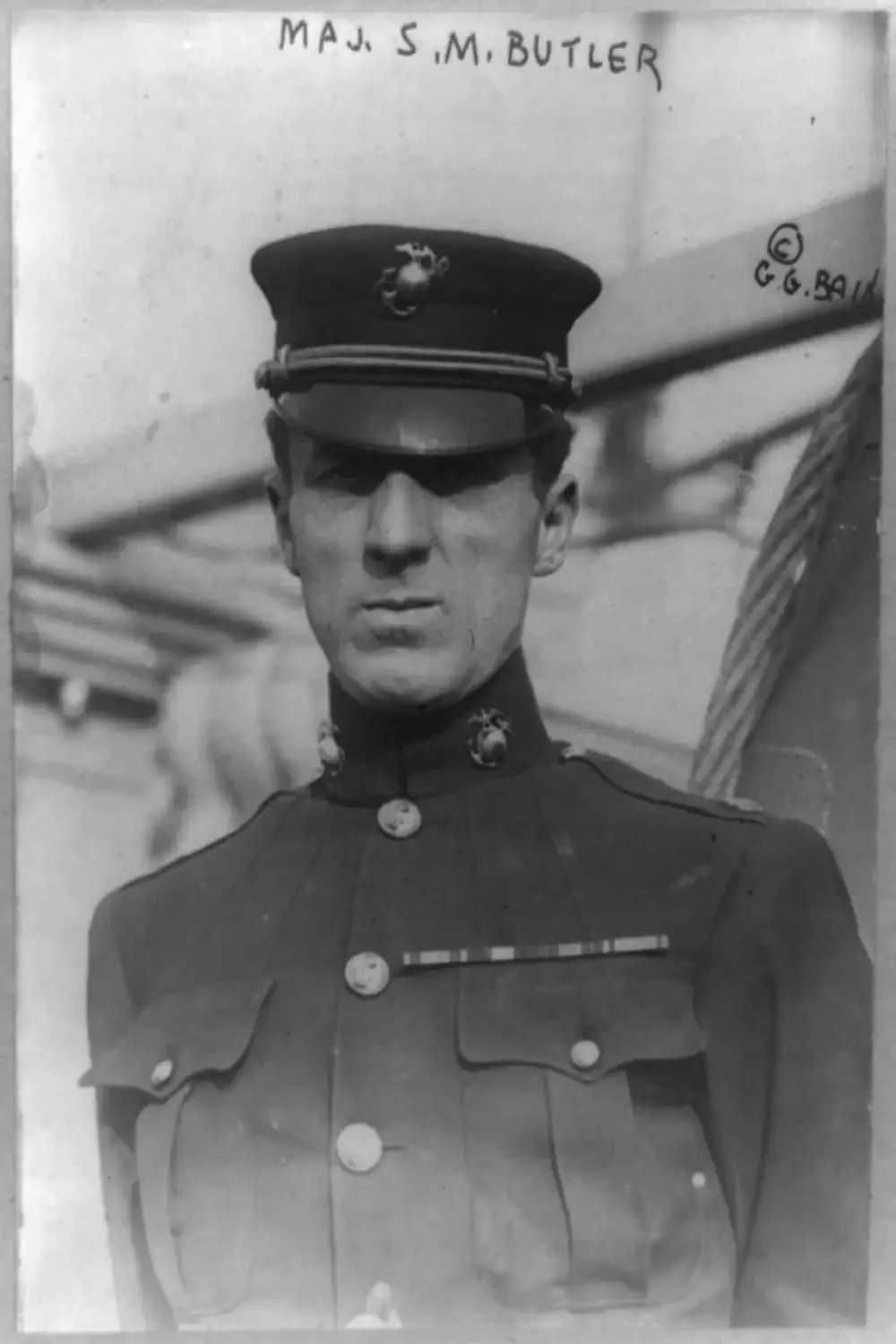
In 1934, retired Marine Maj. Gen. Smedley Butler testified under oath that a bond salesman had sounded him out about leading a veterans' movement. A House committee reported in 1935 that it had verified most of his statements and that such attempts 'were discussed, were planned.' No coup was ever attempted, and the committee said it had no evidence that several famous men named in press reports were involved.
Verdict: Partly True. Part of this story is documented in the sources below. Other parts of the popular theory are not supported by them. How we rate stories
The Story
Smedley Butler was, in the words of a 1935 House report, 'twice decorated by the Congress of the United States,' and by 1933 a retired Marine major general with a large following among veterans. That is why, according to his sworn testimony, someone came calling.
In a public statement released November 24, 1934, the House committee investigating Nazi and other propaganda summarized what Butler told it. About July 1, 1933, he testified, a telephone call from Washington to his home near Philadelphia asked for an interview with two Legionnaires. That day he was visited by Gerald C. MacGuire of New York and William Doyle of Boston.
'There is no question but that these attempts were discussed, were planned' (House committee report, 1935)
At first, by Butler's account, the pitch was about the American Legion: run for national commander, or at least go to the October 1933 convention in Chicago. MacGuire came back several times and urged Butler to make a speech there for a resolution calling for the United States to return to the gold standard. Butler testified that he answered: 'I don't know a damn thing about gold.' On that visit, he said, MacGuire showed him a bank book indicating deposits of about $42,000.
Butler said that over the following year the conversations moved from gold to something bigger. He testified that MacGuire, who had traveled in Europe studying veterans' organizations, proposed forming a large veterans' organization in the United States, with Butler as its leader. In its 1935 report, the committee described this as conversations 'in which the latter is alleged to have suggested the formation of a fascist army under the leadership of General Butler.' Butler testified that he was interested but would not commit to leading it, and warned that if such a group pushed anything that smelled of fascism he would raise more men to fight it.
MacGuire, a bond salesman, testified too and denied it under oath. The committee was not persuaded. Its report to the House, dated February 15, 1935, says it 'was able to verify all the pertinent statements made by General Butler, with the exception of the direct statement suggesting the creation of the organization.' Even that, the report says, 'was corroborated in the correspondence of MacGuire with his principal, Robert Sterling Clark, of New York City.' The report quotes one of MacGuire's letters from France praising the Croix de Feu, a French veterans' league.
The committee's conclusion is the line that keeps this story alive: 'There is no question but that these attempts were discussed, were planned, and might have been placed in execution when and if the financial backers deemed it expedient.'
The same record also sets limits. In November 1934 the committee said it had no evidence that would 'in the slightest degree' justify calling John W. Davis, Gen. Hugh Johnson, Thomas W. Lamont and other prominent men whose names had appeared in newspaper accounts, and that it would not 'take cognizance of names brought into the testimony which constitute mere hearsay.' The 1935 report found no link to any European fascist movement. No organization was formed and no move against the government was made.
So the verdict stays 'Disputed.' A congressional committee said, on the record, that planning happened and that Butler's account checked out. How serious it was, and how far it might have gone, the record does not settle.
Origins
Butler testified in November 1934 before a House special committee chaired by John W. McCormack, with Samuel Dickstein as vice chairman. The committee released a public statement on November 24, 1934, and its report to the House (House Report No. 153, 74th Congress) is dated February 15, 1935.
The Claims
- Wealthy backers planned to use veterans to seize power from President Roosevelt.
- Butler was asked to lead the movement.
- Congress confirmed the plot and then buried it.
Key Evidence
- The committee's 1935 report says it 'received evidence showing that certain persons had made an attempt to establish a fascist organization in this country.'
- It adds: 'There is no question but that these attempts were discussed, were planned, and might have been placed in execution when and if the financial backers deemed it expedient.'
- The report says MacGuire denied the allegations under oath, but the committee 'was able to verify all the pertinent statements made by General Butler, with the exception of the direct statement suggesting the creation of the organization,' which it said was corroborated in MacGuire's correspondence with Robert Sterling Clark.
The Evidence Against
- The report rests the central proposal, a fascist army under Butler, on Butler's testimony and MacGuire's letters. MacGuire denied it under oath.
- The report says: 'No evidence was presented and this committee had none to show a connection between this effort and any fascist activity of any European country.'
- The committee's November 1934 statement said it had no evidence that would 'in the slightest degree' justify calling John W. Davis, Gen. Hugh Johnson, Thomas W. Lamont and others whose names had appeared in press accounts.
- Nothing was ever launched, and the committee published its findings, so the idea that Congress 'buried' it goes beyond the record.
Documents & Sources
- Gov DocumentOfficial RecordInvestigation of Nazi and Other Propaganda, House Report No. 153, 74th Congress, Feb. 15, 1935 (GovInfo, Serial Set PDF) govinfo.gov ↗
- Gov DocumentPublic Statement of the Special Committee on Un-American Activities, Nov. 24, 1934 (GPO print; page transcription on Wikisource) en.wikisource.org ↗
Each link was checked for availability on Oct. 27, 2026. Links open in a new tab.