The Black Knight Satellite
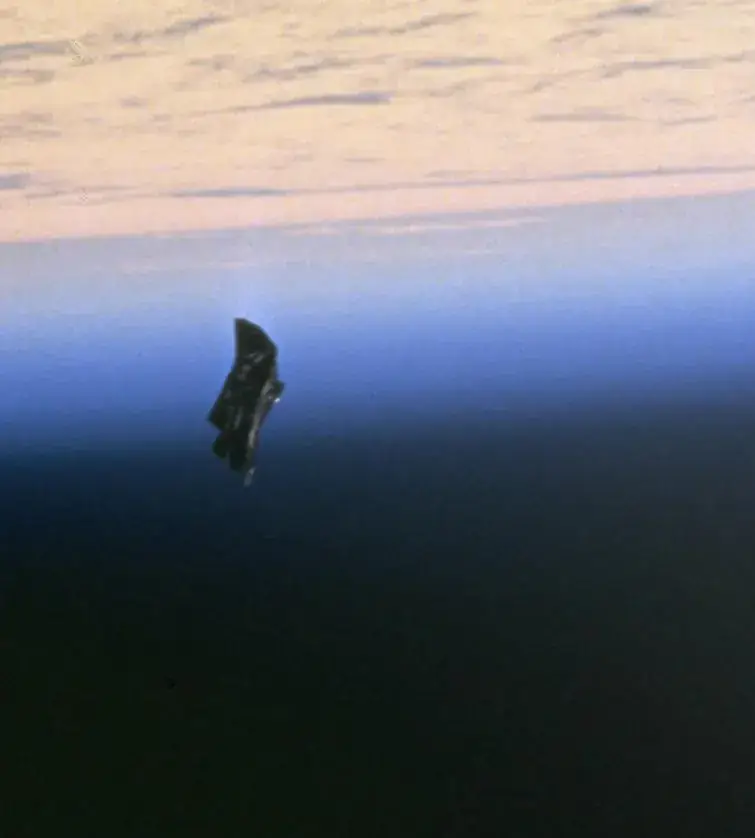
Believers say an alien satellite called the 'Black Knight' has orbited Earth for thousands of years. The legend stitches together unrelated stories. Its most famous photos come from the 1998 STS-88 shuttle mission, and the object in them is identified as a thermal cover lost during a spacewalk.
Verdict: Debunked. The weight of the evidence cited below contradicts this claim. How we rate stories
The Story
According to believers, something dark and artificial has been circling Earth for thousands of years, possibly sent by an alien civilization. They call it the Black Knight.
The legend is not one story but several. In 1899 Nikola Tesla, working in Colorado Springs, recorded radio signals he could not explain. In a 1901 Collier's Weekly article quoted by Popular Mechanics, he wrote that the changes came 'with such a clear suggestion of number and order that they were not traceable to any cause then known to me.' Popular Mechanics suggests he was hearing pulsars or some other natural signal.
'I did four previous spacewalks, never lost an item.' — astronaut Jerry Ross, December 1998, per a CBS News transcript
In 1927 Jørgen Hals, a radio operator in Norway, heard his own transmissions return to him moments later. These 'long-delayed echoes' are real, and Space.com notes they are not fully explained. Popular Mechanics says writer Duncan Lunan later proposed, in Analog magazine, that an object near the Moon could have caused them, and that Lunan has since distanced himself from the Black Knight theory.
More pieces followed. Space.com says newspapers in 1954 published claims by retired Air Force major Donald Keyhoe that the Air Force had detected two artificial satellites, before any nation had launched one. Those claims were never substantiated. In 1960 Time reported a mysterious 'dark object' in orbit. It turned out to be part of an American Discoverer spy satellite, though Space.com and Popular Mechanics name different Discoverer missions.
The modern surge came from photos taken in December 1998 on STS-88, the first shuttle flight to assemble the International Space Station. They show a black, oddly shaped object against Earth. Astronaut Jerry Ross lost several items during the mission's spacewalks, including a thermal blanket, according to a CBS News transcript. 'I don't have the slightest idea what happened,' he said. A public satellite catalog lists a piece of spacewalk debris from the mission that separated on 10 December and burned up in the atmosphere four days later. The photos are strange. The object in them was hardware that drifted away.
Origins
Space.com and Popular Mechanics trace the legend through several separate episodes: radio signals Nikola Tesla reported from Colorado Springs in 1899, 'long-delayed echoes' heard by a Norwegian radio operator in 1927, newspaper claims in 1954, a 1960 satellite report, and photos from the December 1998 STS-88 shuttle mission.
The Claims
- An alien satellite, sometimes said to be about 13,000 years old, orbits Earth.
- It has sent radio signals that Tesla and others detected.
- NASA photographed it in 1998 and has covered it up.
Key Evidence
- Tesla did report unusual radio signals. Popular Mechanics quotes his 1901 Collier's Weekly article: 'The changes I noted were taking place periodically and with such a clear suggestion of number and order that they were not traceable to any cause then known to me.'
- Long-delayed radio echoes are real. Space.com describes the phenomenon as one 'which remains not fully explained.'
- The STS-88 photos are genuinely odd. Former NASA engineer James Oberg told Space.com: 'They're probably some of the weirdest-looking 70-mm photos to ever come out of the shuttle program.'
The Evidence Against
- STS-88 was the shuttle mission that began assembling the International Space Station. NASA's mission page lists Jerry Ross among the crew and says he completed his seventh spacewalk on the flight.
- A CBS News transcript from 15 December 1998, quoted by Lead Stories, says that during the first two spacewalks Ross lost 'a socket fitting, a thermal blanket and an access panel cover.' Ross is quoted: 'I did four previous spacewalks, never lost an item.'
- Jonathan McDowell's GCAT satellite catalog lists object 25570 as 'EVA debris' from the mission, named 'Trunnion pin cover,' separating on 10 December 1998 and re-entering the atmosphere on 14 December 1998. Lead Stories identifies this object as the lost thermal cover.
- Popular Mechanics and Space.com say the 1960 'dark object' turned out to be part of a U.S. Discoverer spy satellite. They disagree on which one (Discoverer 5 or Discoverer 8). Space.com says 1954 claims that the Air Force had detected two artificial satellites 'have never been substantiated.'
Documents & Sources
- Gov DocumentOfficial RecordSTS-88 mission page (NASA) nasa.gov ↗
- AcademicGCAT: General Catalog of Artificial Space Objects, satellite catalog (J. McDowell) planet4589.org ↗
- NewsFact Check: 'Black Knight Satellite' Is NOT 13,000-Year-Old Craft (Lead Stories) leadstories.com ↗
- NewsThe 'Black Knight' satellite: A 120-year-old conspiracy theory (Space.com) space.com ↗
- NewsThe Truth About the 'Black Knight' Satellite Conspiracy Theory (Popular Mechanics) popularmechanics.com ↗
Each link was checked for availability on Oct. 27, 2026. Links open in a new tab.